



What Is a Robot Vacuum? A Complete Beginner's Guide
Floor cleaning is a time-consuming task. But there are fewer people today with as much free time or leisure as they have in the past. Hence, the popularity of the robot vacuum is one of the reasons for its rapid growth across the globe as a smart home appliance.
According to industry reports, the worldwide robot vacuum cleaner market is already valued at billions of dollars, and is set to see strong growth for the next decade. New and improved AI, navigation and battery life are making daily cleaning easier for more families to switch to automated options.
A robot vacuum cleaner can operates automatically. So, why are millions of homeowners making the purchase?
Robot vacuum cleaner is a small device that cleans up your floors automatically, without requiring you to push the machine around. It is equipped with smart navigation, brushes, sensors, and motors to gather dust, dirt, pet hair and other dirt particles off multiple types of flooring.
A vacuuming robot works and cleans while you are working, relaxing or even sleeping, unlike a traditional vacuum. Some of the newer models also make themselves automatically back to the charging station once they are charged, and then they clean even after they are refueled.
Some models take it even one step further. A robot vacuum/mop can be used to vacuum and mop the floor in one go. Premium models can clean their dustbins, wash their mop pads and draw maps of your home.
You do not use a vacuum previously? Well, then this guide will answer the most FAQ when trying to pick the first one.
By this article, you'll be able to understand:
- What a robot vacuum is made of
- How robots vacuum cleaner works
- Its cleaning capabilities and limitations. How well it cleans and what it does not.
- The biggest robot vacuum cleaner benefits
- The advantage and disadvantage of robot vacuum.
- How to select the optimal robot vacuum for your home.
- You need to make the decision on whether you are going to purchase a robot vacuum cleaner or not.
Start with the basic.
What Is a Robot Vacuum?
The answer is very simple: A robot vacuum is a self-propelled machine equipped with a vacuum cleaner that can clean your floors without requiring any assistance from humans.
When someone inquires what is a robot vacuum, it's easy to explain. Sweepingly small machine which is designed to be moved around the house, identify obstacles, avoid stairs, and clean regularly from dust, crumpled paper, pet hair and daily dirt from your floors.
Another frequently asked question is what is robot vacuum cleaner?
A robot vacuum cleaner is simply another name for a robot vacuum. They are both used to refer to the same kind of smart home appliances. It integrates sensors, electric motors, rechargeable batteries, software and cleaning brushes all in a small device.
No more carrying a heavy vacuum cleaner from room to room: you can press a button, set a schedule or make use of a mobile app. The automatic vacuum works for you!
What Does a Robot Vacuum Do?
What is a robot vacuum? is one of the most googled questions around the internet. It is basically used to maintain your floors and clean them automatically.
Depending on the model, a floor cleaning robot can:
- Pick up dust and dirt
- Remove pet hair
- Collect crumbs
- Vacuum under beds and under sofas
- Use a vacuum cleaner to clean carpets and hard floors.
- Clean regularly as per schedule
- Automatically returns to charging station
- A number of the high quality ones also have other sophisticated features.
For instance, if you have a robot vacuum mop, it can vacuum before it mops the same floor, without requiring additional effort from you. Others even have the capability to wash hard floors and pick up dust in a single process, which is a combination of a vacuum cleaner and a mop.
Why Are Robot Vacuums So Popular?
They are not interested in carrying out the hefty vacuum cleaner for every weekend around the house.
The modern cleaning robot provides ease of use.
- It cleans even when you are not at home.
- It can cleans as you watch TV.
- Even you're sleeping.
A robot floor cleaner is used to help keep floors clean on a daily basis, rather than replacing each deep cleaning. This translates to reduced dust, less crumbs and less long-term pet hair build up.
This is actually among the largest reasons why many homeowners these days are now looking into buying a best robot cleaner as a part of their home instead of a luxury.
Now the question is-
Is a Robot Vacuum the Same as a Regular Vacuum Cleaner?
No.
The traditional vacuum cleaner will have a better suction for the deep clean. It calls for moving, carrying or pushing the machine within the house. This is not the case with a robotic vacuum cleaner.
Designed for maintenance cleaning, on a regular basis. It moves on its own accord, automatic navigation, navigates mapped paths, can avoid obstacles, and cleans often without a human being around. This makes both of them effective in different circumstances. In many homes there is two of these!
They employ a best robot vacuum cleaner to clean regularly and a regular vacuum cleaner for deep cleaning once in a while. In the following section, we will go inside the robot vacuum and dive into how it can tell where to go, how it can avoid furniture and how it can clean your floors completely on its own.
How Does a Robot Vacuum Work?
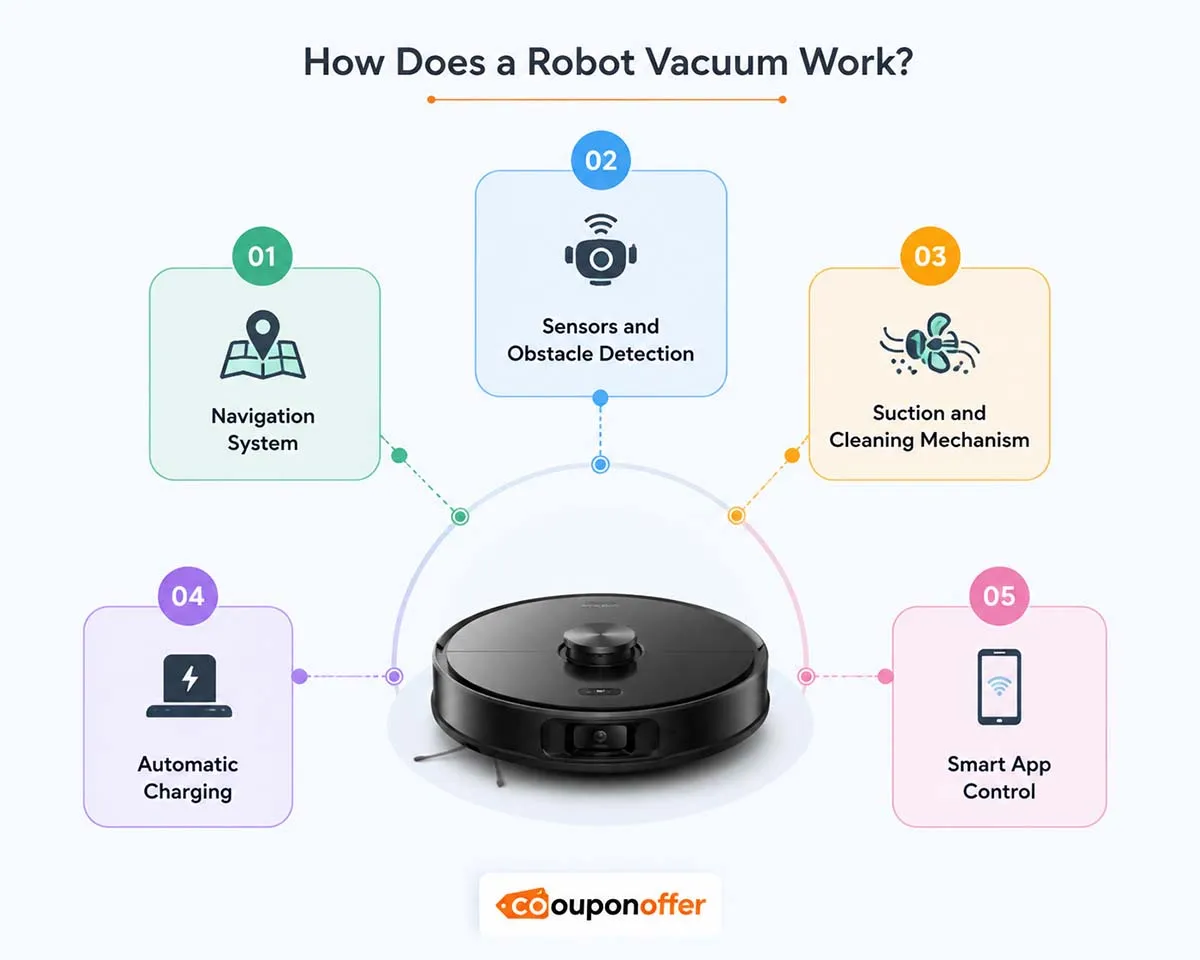
A robot vacuum can initially appear to be a small device that is wandering around randomly. But new models are much savvier than they seem.
A robot vacuum cleaner is a technological solution that is powered by a set of sensors, cameras, lasers, software and electric motors, which will help it to learn your home and vacuum it the smart way. Some high-end models can even learn over time with the help of artificial intelligence (AI).
The process is simple in the sense that:
- The robot is looking around.
- It operates the cleaning route.
- Uses brushes and suction to gather dirt.
- A robot vacuum won't bump into objects or climb up and down the stairs.
- When the battery level is low, it goes back to the charging dock.
- Let's look at each part in more detail.
1. Navigation System
The navigation system is the brain of a vacuum robot. Unlike traditional robots, the modern ones make a virtual map of your house. This assists them to clean each room more effectively and without duplication of effort.
A robot cleaner can use:
- LiDAR laser navigation
- Cameras
- Infrared sensors
- Gyroscopes
- AI-powered mapping
Routine cleaning is used in entry-level models. Premium models will retain room layouts and can clean rooms on command. This intelligent navigation is one of the reasons many opt for the best robot vacuum over older versions of the device.
2. Sensors and Obstacle Detection
One of the frequently asked questions is:
A robot vacuum is able to avoid furniture, how?
The answer is simple. It has several sensors to sense its environment.
A robotic vacuum cleaner can detect:
- Walls
- Furniture
- Table legs
- Toys
- Shoes
- Stairs
- Cliffs or ledges
If it comes across an object, it takes its foot off the accelerator, turns or slowly circumnavigates the obstacle. These have been trained to identify common household objects such as cables, pet bowls, slippers, and pet waste as well, in high-end models. This allows for cleanings to be performed safely and avoids the risk of being trapped during cleaning.
3. Suction and Cleaning Mechanism
When the robot is able to determine where to go, it begins cleaning. Typical floor cleaning robot has a brush rotating mechanism and strong suction.
Typically, the cleaning process involves the following steps:
- Side brushes act as a draw card to draw dirt toward the middle.
- Main brush loosens dust and debris.
- The suction motor sucks everything in to the dustbin.
- The filter retains the fine dust before sending clean air.
With this combination, the vacuum cleaner robot is able to clean:
- Dust
- Hair
- Pet fur
- Food crumbs
- Sand
- Small debris
Some newer models will automatically adjust the suction when they sense carpets. This helps to enhance cleaning performance without reducing battery usage on hard floors.
4. Automatic Charging
One of the smartest robot vacuum cleaner functions is automatic charging. It doesn't need to be plugged in after each cleaning.
If the battery is low, the automatic vacuum will return to the charging dock automatically. There are also many high quality models that have the ability to recall the stop location during cleaning.
Once they recharge they pick up from where they left off rather than beginning again. This is a great feature in a bigger house.
5. Smart App Control
The majority of the latest best vacuum robot models are wireless and will be linked to a cell app. The application allows you to control the robot from anywhere.
Common features include:
- Turn on or off the cleaning cycle.
- Schedule daily cleaning
- Check out your home's cleaning map!
- Select specific rooms
- Set no-go zones
- Check battery level
- Receive maintenance reminders
There are also many models that will take place with voice assistants such as Amazon Alexa and Google Assistant. It can be operated just by voice command, and its cleaning action begins.
Will a Robot Vacuum be able to learn your home?
Yes. Many high quality models can. One more question many people ask before purchasing a robot vacuum cleaner is this.
During the first few cleaning sessions, robots with smart mapping create a digital layout of your home.
With time, they come to learn:
- Room locations
- Furniture placement
- Cleaning routes
- Frequently used areas
In certain instances, AI models can suggest additional cleaning in areas that see a lot of use, like kitchens, dining rooms, or entryways.
The more efficient and quick the cleaning robot is able to function, the better the navigation system.
Can a Robot Vacuum pick up all the dirt?
Most open floor areas are very well cleaned, but I would go so far as to say - no machine is perfect. A robot vacuum may have difficulty with:
- Tight corners
- Very high thresholds
- Thick cables
- Extremely cluttered rooms
- Spaces less than the width of the robot
For this reason, once a while cleaning with a regular vacuum would be useful. But for everyday use, the top robot vacuum cleaner will keep most homes cleaner with hardly any effort. Now that we've covered this, let's take a look at the key parts of a robot vacuum and understand their function and significance in selecting the best model for you.
Main Components of a Robot Vacuum

A robot vacuum may seem like a straightforward device, but it has a few important components that can help you keep your floors clean.
With this knowledge, you should be able to understand how a robot vacuum works and what you can expect from various models. It also helps keep your machine in top condition and parts available in case of any need.
Let's take a few of the most vital elements.
Wheels
The wheels enable the vacuum robot to move throughout your home. The powered drive wheels are typically two, with one small wheel for balancing on the rear.
These wheels enable the robot to turn, switch directions, climb up small changes in floor surface and walk from room to room. If the rugs are small or there is a low door threshold there are premium models that can cross the threshold without getting stuck.
Side Brushes
The brushes on the side are under the robot cleaner. Their function is to clean the dust and debris from the edges of walls, corners and furniture to the middle of the robot. If there weren't any side brushes, dirt on the edges of a room would be more difficult to pick up. Most best robot vacuum offers one or two side brushes for optimum edge cleaning.
Main Brush Roll
The main brush roll is located under the robot between the wheels. The rotating brush picks up dirt, dust, crumbs and pet hair from the floor as the robotic vacuum cleaner rolls up.
Different brushes will be more successful on various surfaces. A few brushes are created out of 100% rubber for less tangled hair. Some mix of rubber and bristles for carpet cleaning. Having an anti-tangle brush is a great feature for those who have pets as it can save you a lot of time in cleaning.
Suction Motor
The suction motor drives air flow which sucks dirt into the dustbin. This is among the most crucial robot vacuum cleaner capabilities. The stronger the motor, the better the cleaning will be, particularly when it comes to cleaning carpets and rugs.
But that's not the only thing to consider. All of this contributes to better cleaning by using good brush design, smart navigation and correct airflow. The best vacuum cleaner robot is never the most powerful or with the highest vacuums.
Dustbin
All robot vacuums come with their own dustbin to store dirt and debris. All items collected by the robot when cleaning the space are held in the dustbin.
It can be different sizes depending on the model. The bigger the dustbin, the less times you'll be required to empty it, which is beneficial for larger residences or pet owners.
High-end models collect the dust in the dustbin and automatically transfer it to a larger base station after each cleaning cycle.
Filters
Filters enhance air quality while robot is cleaning. The majority of the modern robot vacuum cleaners have high efficiency filters that capture fine dust, pollen and allergens before sending clean air back into the room.
Many high-quality models feature HEPA filters, which can be beneficial for those with allergies or asthma. Regular filter cleaning or replacing is necessary to ensure good filter cleaning performance and good suction.
Battery
All of the automatic vacuum is powered by the battery. The robot will operate until the batteries run out, which depends on the capacity of the batteries.
Most models today can run for about 90-180 minutes per charge, depending on the mode of cleaning and the type of floor. The more powerful the robot, the longer it will run on a single charge and the more likely it is to charge itself automatically.
Sensors
The most innovative component of a floor cleaning robot is the sensor. They assist the robot in its understanding of its environment and in cleaning safely. Common sensors include:
- Obstacle sensors
- Cliff sensors
- Wall sensors
- Dirt detection sensors
- Floor detection sensors
- Navigation sensors
The sensors help the robot avoid danger of falling down stairs, crashing hard into furniture or missing out on important places to clean. The premium models employ cutting-edge artificial intelligence and LiDAR sensors to generate extremely accurate maps of your home.
Charging Dock
The robot's home is the charging dock. The robot floor cleaner will return to the dock for recharging when the battery is low. Many high-end docking stations much more than recharge. Some can:
- Automatically empties the dustbin.
- Wash mop pads
- Use warm air to dry mop pads.
- Top up clean water tank
- Keep collected dust for a couple of weeks.
These features can lower maintenance costs, and owning a robot vacuum and mop combo is much more convenient.
Why are These Components Important?
All components of a robot vacuum have an impact on how well they clean. For example:
- A better wheel will help to move easily on various floor surfaces.
- The more powerful suction, the more dirt that is removed from carpet.
- Smart sensors minimize collisions and unfilled spots.
- High quality filters can help make the air in the home purer.
- Longer cleaning periods are afforded by larger batteries.
- Advanced docking stations need very little manual maintenance.
Which is why specs are not the only things to consider. The ideal robot vacuum is a combination of good hardware and intelligent software that provides a dependable daily vacuuming experience.
We will now look at the various types of robot vacuums and let you know which one is suited to which home, budget, and cleaning requirements.
Types of Robot Vacuums
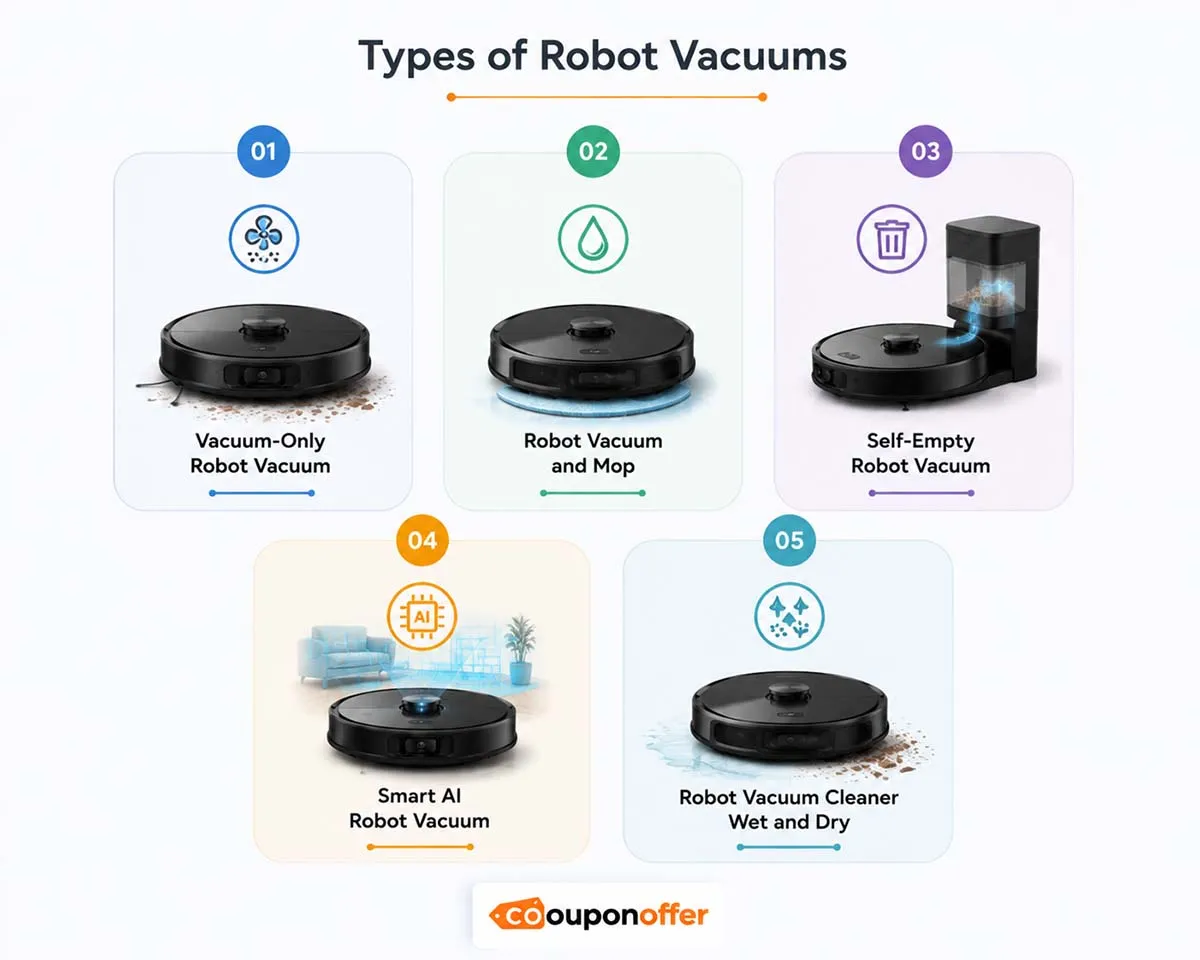
Not all robots vacuums are designed in the same way. There are some models that concentrate on the basic vacuuming done daily. Others can also automatically wash mop pads, empty their own dustbins, mop and vacuum.
Knowing the different kinds will assist you in picking the right one for your residence and budget. Let's take a look at the most popular choices that are available today.
1. Vacuum-Only Robot Vacuum
Vacuum Only is the simplest type of robot vacuum cleaners. It's used primarily for removing dust, dirt, crumbs and pet hair from your floors. Does not MOP or use water.
This type is a good choice for people who:
- Have a traditional mop already?
- Eliminate the chore of vacuuming every day with automatic vacuuming.
- Have predominantly carpets or rugs
- Are looking for a more affordable option
Common entry level and mid-range models are in this category. A model that only sucks up dust may be a great starting point, if you are looking to prevent dust buildup on your floors caused by daily use.
2. Robot Vacuum and Mop
The fastest growing category is the robot vacuum and mop. These models will not only vacuum, but can also mop hard floors in one pass. Most include:
- A dustbin
- A clean water tank
- Washable mop pads
- Smart water control
A robot mop removes light stains, footprints and fine dust after vacuuming. These are the models that perform best on:
- Hardwood floors
- Tile floors
- Laminate flooring
- Vinyl flooring
A robot vacuum mop can save even more time if you have a home that's predominantly hard floors.
3. Robot Vacuum Mop Combo
There is often a question which is whether there's any machine which can do everything. The answer is yes.
A robot vacuum and mop combination is a vacuum cleaner and mop machine that can be operated simultaneously in a smart device. One unit does both jobs and so you don't need to purchase separate machines.
Many high quality models have the ability to:
- Vacuum first
- Mop afterward
- Detect carpets automatically
- Raise mop to be able to cross rugs.
- Mop up after carpeted areas are cleared.
This makes a best robot vacuum and mop a perfect choice for households having mixed flooring.
4. Self-Empty Robot Vacuum
The self-emptying robot vacuum cleaner is one of the greatest advancements in the past few years. The robot removes the dust into the bigger bag inside the docking station, instead of emptying the dustbin after each time it has been used for cleaning. Some of the docking stations can contain several weeks of dust without emptying.
Ideal for:
- Busy households
- Large homes
- Families with pets
- Those with less maintenance needs.
These models are more expensive but provide one of the most convenient cleaning experience around.
5. Smart AI Robot Vacuum
The fifth is a Smart AI Robot Vacuum. The latest generation of cleaning robot adopts artificial intelligence to clean more efficiently. AI models can identify objects and take more intelligent decisions as they clean, rather than stick to a simple pattern.
Many high quality robots are able to spot:
- Shoes
- Power cables
- Pet bowls
- Toys
- Furniture legs
- Pet waste
Even some of the models propose cleaning plans according to the habits of each person. For the latest technology, a smart AI vacuum cleaner robot is the most automated one.
6. Robot Vacuum Cleaner Wet and Dry
The other popular choice is a robot vacuum that is wet/dry. These robots are able to pick up dry debris in addition to using water to clean hard floors, which is not possible with simple vacuum models. Usually, a robotic vacuum cleaner wet and dry comes with the following features:
- Vacuuming mode
- Mopping mode
- Adjustable water flow
- Multiple cleaning settings
They are designed to clean on a daily basis from all day dust, pet hair, footprints, and light spills on sealed hard floors. Remember that they are not to replace heavy duty scrubbing and are not suitable for large liquid spills.
Which Type is right for you?
The choice of the right robot vacuum will depend on your home, cleaning need and budget. Let's make a simple comparison:
There is no single model that fits every home. The best robot cleaner is the one that matches your floor type, lifestyle, and cleaning routine.
Before buying, think about:
- The size of your home
- Whether you have carpets or hard floors
- If you have pets
- How much maintenance you're willing to do
- Your budget
Answering these questions will help you narrow down your options and choose a model that delivers the best value.
Now, we'll look at what a robot vacuum can clean, including hardwood floors, carpets, rugs, tiles, pet hair, and other common household surfaces.
What Can a Robot Vacuum Clean?
A common question customers may ask is, what kind of floors can a robot vacuum operate on?
Yes, for the majority of homes.
Today's robot vacuum cleaners come in a variety of models that are designed to clean different types of floors. Nevertheless, the effectiveness of cleaning is influenced by the model, its suction power, brush design and navigation.
Let's delve into where a robot vacuum shines.
1. Hardwood Floors
One of the best vacuum cleaners for hardwood floors is a robot vacuum cleaner.
Fine dust, pet hair, crumbs and dirt easily gets trapped in hardwood floors. A daily clean up will help to stop this debris from spreading around your home.
Most modern robots have soft wheels and brushes which do not harm the sealed hardwood floors. Many high-end models also self-regulate their suction, letting you enjoy efficient cleaning without harming the surface. If the house consists of mostly hardwood flooring, a robot vacuum/mop may make it even easier to clean as it vacuums and mops at the same time.
2. Tile Floors
Robot cleaners will typically easily clean tile floors. Unlike carpet, dust, crumbs, sand and pet hair are lying on the surface rather than getting stuck.
There are several different types of cleaning robots for floor cleaning and tiles can be cleaned in a short time and then followed by light mopping to clear up footprints and fine dust.
When you have a kitchen, hallway or bathroom with tile floors, automatic cleaning can help keep them looking fresh every day.
3. Laminate Flooring
Laminate floors are not only prone to regular cleaning but also need gentle care. A good robot vacuum cleaner will pick up the normal dirt without damaging the surface.
If you select a robot vacuum mop, find one that has a water control adjustment. Using too much water on laminate flooring is not recommended. Most of the high quality models enable to save the quantity of water as you mop, which is safer for laminate flooring.
4. Vinyl Flooring
A vacuum robot is an excellent choice for vinyl flooring as well. Removes dust and small debris easily, as they remain on the surface.
The other popular type of home robot vacuum cleaner is a robot vacuum and mop—a combination that's the best option for keeping vinyl floors clean with little effort. Frequent dusting will prevent dirt from accumulating and make the floor appear fresher and longer.
5. Carpets
It is a frequent question whether a robot vacuum can function on carpets. Yes, but results can differ for different carpets and the different robot. Most of the modern robotic vacuum cleaner models can clean:
- Low-pile carpets
- Medium-pile carpets
- Area rugs
- Entrance mats
Premium models have a suction automatically that gets higher when they are moving onto carpet. This aids to reduce the amount of dust, fur, etc. from the carpet. Some robots may still struggle with very thick and/or high pile carpets. When your home is carpeted, it's crucial to have a model with good suction and carpet-detecting capabilities.
6. Rugs
A robot vacuum typically can easily clean rugs. However, lightweight rugs with curled edges or loose tassels may cause problems.
Some robots may:
- Push lightweight rugs
- Grab just the border of a rug.Grab the edge of a rug.
- Tangled up in long fringe
High end models have more sophisticated sensors that identify rugs and cross them more easily. Flat edges on the rugs can also enhance the cleaning process.
7. Pet Hair
One of the top groups of people using robot vacuum cleaners are pet owners. Dogs and cats shed daily and hair can easily accumulate under furniture and around the walls. A good floor cleaning robot is beneficial for removing:
- Dog hair
- Cat hair
- Pet dander
- Scrub up pet areas with litter
- Daily dirt from the outside
If you have pets, search for:
- Strong suction
- Rubber brush rolls
- Anti-tangle brushes
- Large dustbins
- High-efficiency filters
All of these features make it easier to clean your floors every day and will help limit hair on your floors.
Is it possible for a Robot Vacuum to clean underneath furniture?
Yes.
The low profile is one of the greatest benefits of a robot vacuum cleaner. It's extremely short in comparison to a standard vacuum, so you can easily use it to clean under:
- Beds
- Sofas
- Coffee tables
- TV stands
- Cabinets
- Dining tables
These are places that many people don't clean routinely. The automatic daily dust removal helps reduce dust in difficult-to-access areas.
Can it take the dirt of everyday?
Yes.
Cleaning robot is a machine to be used for regular cleaning.
It is easily collected by:
- Dust
- Crumbs
- Pet hair
- Sand
- Small leaves
- Food particles
- Everyday household debris
Thus it's perfect to maintain floors continuously clean in between deep cleaning.
What a robot vacuum cleaner can't do!
While today's robots are very capable, they also have a limit to what they can do. The purpose of a robot vacuum is not to clean everything.
May have a difficulty in:
- Large liquid spills
- Wet mud
- Lots of trash on top of each other
- Construction dust
- Long cables
- Very cluttered rooms
- High-pile carpets
- Stairs
In such cases, the classic vacuum or hand cleaning is still the best option.
When it comes to cleaning, do you need a Robot Vacuum?
Yes, for many homes.
A robot vacuum cleaner will be great at keeping up with regular dust, pet hair, crumbs and light debris that can accumulate over the course of the day. It doesn't eliminate the need for deep cleaning altogether, but it certainly cuts down on how much manual vacuuming a lot of people will have to do.
This is why it is considered one of the most practical smart home devices around. In the next part of the article, we'll discuss the features you should look for in a robot vacuum and the essential features to invest in and those to avoid.
Key Features to Look for in a Robot Vacuum
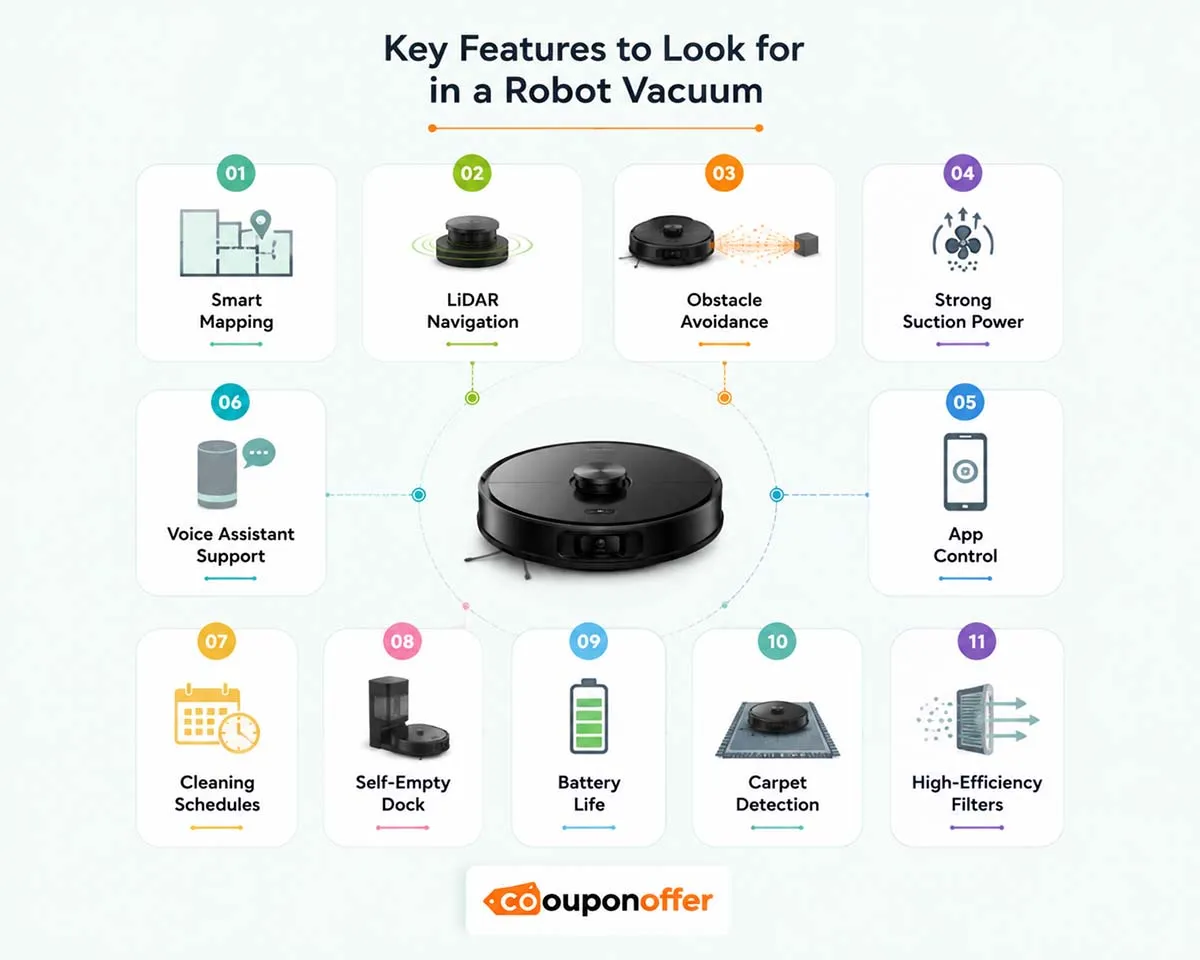
Robot vacuums aren't all built the same way. Some just handle the basic, everyday stuff — nothing fancy. Others use smarter tech and barely need you to lift a finger. Point is, knowing which features actually matter can save you from spending on stuff you'll probably never touch. And honestly, it just makes finding the right vacuum for your home — and your wallet — a whole lot simpler.
So here's what's actually worth paying attention to before you buy.
Smart Mapping
Probably one of the best upgrades you can get in a robot vacuum these days. Instead of just bumping around the house randomly, it actually builds a digital map as it goes.
What that gets you:
- It cleans room by room instead of wandering
- It remembers your home's layout, so no relearning each time
- It won't waste time cleaning the same spot twice
- The whole cleaning run finishes quicker
Quite a few models also let you save maps for different floors — great if you've got a multi-story house. If your place is on the bigger side, smart mapping isn't a "nice to have." It's pretty much essential.
LiDAR Navigation
LiDAR — Light Detection and Ranging, if you're wondering — uses lasers to scan your home and build maps that are scary accurate.
You'll see this a lot in the pricier vacuum models, mostly because it works just as well at night as it does during the day. Stack it up against older navigation systems, and LiDAR usually wins on:
- Speed — it maps faster
- Smarter routes, less wasted movement
- Fewer missed corners
- Better room-by-room recognition
- Overall, just cleans more efficiently
If dependable navigation is what you're after, LiDAR's honestly hard to beat right now.
Obstacle Avoidance
Nobody wants a vacuum that just plows into everything like it's got no clue what's around it. A good one actually notices what's in its way and steers clear. Decent obstacle detection can usually spot things like:
- Shoes left out
- Toys
- Charging cables snaking across the floor
- Pet bowls
- Furniture legs
- Whatever random small stuff ends up on your floor
The fancier AI-powered ones? They can often spot these things before they even get close — not after bumping into them first. Less interruptions for you, and the robot actually gets through its whole cleaning run instead of giving up halfway and calling for help.
Strong Suction Power
Honestly, this is probably the first thing most people think about when shopping for a robot vacuum — and for good reason. Better suction means it actually pulls up:
- Dust
- Pet hair
- Crumbs
- Sand
- Dirt hiding deep in your carpet
But here's the thing — suction alone won't save a bad vacuum. You also need:
- Brushes that actually work
- Good airflow
- Navigation that's not just randomly wandering
- Filters that trap the dust instead of blowing it back out
Put all of that together, and that's when you actually get a clean floor — not just from one feature doing all the heavy lifting.
App Control
Pretty much every robot vacuum worth buying connects to an app now. And once it does, you're basically in control no matter where you are. Depending on the model, you can:
- Start or stop it whenever
- Set a schedule so it just runs on its own
- Tell it to clean one room and skip the rest
- Look back at what it's already cleaned
- Block off areas you don't want it going near
- Check how much battery's left
- Get a nudge when it needs maintenance
It's just... easier. You're not stuck dragging a heavy vacuum around the house every time — you can basically set it and forget it.
Voice Assistant Support
Honestly a lot of the good robot vacuums now just work with whatever smart home stuff you've already got. Alexa, Google Assistant, and Siri too — though with Siri it really depends on the model, so check before assuming.
Say "start cleaning the living room" and that's it, off it goes. No phone, no app, nothing. If you're already into smart home gadgets, this one just kind of slots right in.
Cleaning Schedules
Doesn't sound like much but it saves more time than you'd think. Set it once, forget about it — no more remembering to vacuum. Morning, right after work, weekends, even overnight while you're asleep — whatever works for your routine.
A lot of people honestly stop thinking about it altogether after a while. You just walk in and the floor's clean. That's kind of the whole point.
Self-Empty Dock
Emptying the dustbin every time gets old real quick, not gonna lie. A self-empty dock takes care of that for you — the robot finishes cleaning, heads back, and dumps everything into a bigger bag sitting inside the dock. Some can go weeks like that without you touching it. If convenience is the main thing you care about, this feature's kind of a big deal.
Battery Life
Bigger than people usually realize. It's basically what decides how much floor your vacuum can actually get through before it taps out. Big house, more rooms — you'll want more battery. Most higher-end ones recharge on their own too, and just pick up where they stopped instead of restarting from scratch. Makes a real difference if your place has a lot of rooms or more than one floor.
Carpet Detection
Most houses aren't all one flooring type — some carpet here, hard floor there. A good vacuum should notice that instead of treating it all the same. The better ones tend to bump up suction once they hit carpet, ease off on hard floors, lift the mop automatically over rugs, and just skip mopping carpet altogether.
None of that needs you doing anything — it just happens.
High-Efficiency Filters
Not something people usually think about, but it matters more than you'd guess for air quality indoors. A lot of vacuums now come with HEPA-style filters that catch fine dust, pollen, pet dander, that kind of thing.
Worth paying attention to if anyone's dealing with allergies, or you've got pets around. And don't forget to actually clean or swap the filter now and then — otherwise suction starts dropping off without you noticing.
Which Features Should You Prioritize?
The best features depend on your home and cleaning needs. Here are some quick recommendations:
Look, you don't need to chase every premium feature just because it exists. That's kind of a trap people fall into. The "best" robot vacuum isn't the one stacked with the most features — it's whichever one actually works for your life. Your floors, your budget, how you actually live day to day. That's what should decide it, not some spec sheet.
Anyway — up next, we'll get into why robot vacuums have become such a normal part of people's cleaning routines these days. There's a reason so many homeowners swear by them now, and it's worth digging into.
Benefits of Using a Robot Vacuum
Calling a robot vacuum "just a gadget" kind of undersells it. For a lot of households, it's turned into an actual part of the daily routine — not a novelty sitting in the corner. You stop setting aside time to vacuum, the machine just does it, and you get to spend that time on literally anything else. That's the whole draw here, honestly, and it explains why so many people have one now.
So let's break down the biggest wins.
Saves Time Every Day
Ask most owners why they bought one, and time comes up first. No more pushing a vacuum around the house yourself — the robot does its thing in the background while you're off doing something else. Work. Cooking. Watching TV. Hanging out with the kids. Even just sleeping.
Fifteen, twenty minutes a day doesn't sound like much on its own. But stack that up over weeks, and it's a decent chunk of time back in your life — especially if your schedule's already packed.
Keeps Floors Clean with Less Effort
Dust doesn't wait for a good time to show up — it just builds up, day after day, whether you notice or not. Crumbs land after every meal. Pet hair somehow always ends up bunched in corners. A robot vacuum catches most of this before it turns into an actual mess you can't ignore. Instead of cleaning reactively — waiting till the floor looks bad — it just keeps at it steadily, so things stay decent all week. That's honestly why plenty of owners run theirs once or even twice daily.
Reduces Dust and Allergens
It's not just about how the floor looks, either — dust actually affects the air you're breathing indoors. Quite a few robot vacuums now ship with high-efficiency filters designed to grab:
- Dust
- Pollen
- Pet dander
- Fine particles that would otherwise just float around
And there's a bonus here — cleaning regularly stops dust from spreading around the house in the first place. If allergies or mild asthma are something you or your family deal with, this one's genuinely worth factoring in.
Makes Life Easier for Pet Owners
Anyone who's got a dog or cat knows the drill — hair ends up everywhere, floors, rugs, couches, you name it. And that's not even counting the dirt they drag in after being outside all day. A robot vacuum takes a good chunk of that daily shedding problem off your plate before it turns into an actual mess.
Pet-friendly models usually pack in stuff like:
- Strong suction
- Rubber brush rolls instead of the usual bristles
- Brushes made specifically so hair doesn't tangle up in them
- Bigger dustbins — because pet hair fills those up quick
- Filters strong enough to actually keep pace
All that combined, and cleaning up after pets daily just stops being such a hassle.
Cleans Under Furniture
There's always a few spots a regular vacuum just won't reach right — under the bed, under the couch, behind cabinets, under the coffee table. You know exactly which ones I mean.
A robot vacuum, especially the slimmer ones, can actually slip into those tight spaces and get them cleaned without you lifting a finger. And that matters, because those are usually the exact spots people forget about — or just give up on — during regular cleaning.
Works Even When You're Away
This might be the biggest selling point of the whole thing — you don't even need to be home. People just set it running while they're:
- At work
- Out shopping
- At the gym
- Even away on a trip
Come back, and the floors are already done. Try getting that kind of convenience out of a regular vacuum — pretty much impossible.
Supports a Cleaner Home Every Day
Weekly deep cleans are useful, no argument there. But daily upkeep takes things a step further. A robot vacuum picks up the small stuff before it snowballs into something bigger. Over time, that adds up to:
- Noticeably less dust lying around
- Fewer crumbs underfoot
- Floors that just look better day to day
- Less pet hair collecting in corners
- A lot less work when your actual deep clean rolls around
It's not really about ditching manual cleaning for good — more like it fills in the gaps, so your home stays steady instead of bouncing between spotless and messy.
Encourages Better Cleaning Habits
Funny thing a lot of owners notice after getting one of these — they start keeping their floors tidier without really meaning to. You end up picking up shoes, toys, cables, whatever's lying around, mostly just so the robot doesn't get stuck on it. And somehow, that habit just... sticks. Over time, the whole house ends up more organized than it probably was before.
Saves Energy and Physical Effort
Let's be honest, vacuuming isn't exactly easy on the body — especially for:
- Older adults
- People dealing with arthritis
- Anyone with back issues
- Or just anyone whose mobility's limited in general
For folks in these situations, a robot vacuum takes a real load off when it comes to daily floor cleaning. It's not going to handle every single cleaning task out there, sure, but it does cut down massively on how often you'd otherwise need to vacuum by hand.
Integrates with Smart Homes
A lot of the better robot vacuums these days just plug right into your smart home setup. Once that's sorted, you can:
- Kick off a cleaning session with a voice command
- Set up schedules that just run automatically
- Control it remotely, wherever you happen to be
- Get cleaning reports sent straight to your phone
All of that just makes keeping the house maintained a little less of a hassle.
Five Everyday Benefits at a Glance
People often just want the short version — what's actually in it for you if you get one of these things? So here goes: you get your time back since it cleans on its own, your floors stay cleaner day to day instead of just once a week, dust and pet hair stop piling up the way they used to, it actually gets under the couch and bed without you having to move anything, and honestly, you're barely lifting a finger once it's set up.
That's really the whole pitch in a nutshell — and it's basically why robot vacuums have gone from a novelty to something a lot of regular households just have now.
Is a Robot Vacuum Worth It?
A question that comes up a lot with first-timers is whether a robot vacuum's actually worth the money. And for most people, honestly — yeah, it is.
It won't take over every cleaning job in your house, that's just not realistic. But it does cut down significantly on how much manual vacuuming you're stuck doing. If convenience matters to you, along with cleaner floors and that steady, day-to-day upkeep, then it's usually money well spent.
That said, nothing's perfect. Every model out there has its ups and its downs.
Limitations of Robot Vacuums
A robot vacuum's got a lot going for it, sure, but it's far from flawless. Knowing where it falls short matters just as much as knowing what it's good at — that's really what helps you pick the right model and go in with expectations that actually match reality.
If you're wondering what the downside of owning one actually is, well, it kind of depends — your home, what you actually need cleaned, and which model you end up going with all play a part.
Here's a rundown of the limitations people run into most.
It Cannot Replace Deep Cleaning Completely
A robot vacuum's basically made for the everyday grind, not the tough jobs. And it's genuinely good at that — daily dust, crumbs, pet hair, all the stuff that piles up fast. But deep cleaning still has to happen sometimes. There's no getting around that part.
Some things just still need a real vacuum, honestly:
- Thick, plush carpet
- Upholstery
- Mattresses
- Curtains
- Car interiors
- Stairs
A lot of people just end up keeping both around, if we're being real. Robot handles the daily mess, and the regular vacuum comes out whenever something actually needs a deep clean.
Corner Cleaning Is Still Limited
Round shape, that's the thing with most robot vacuums — and round doesn't exactly play nice with sharp corners. Side brushes try to sweep the dirt toward the suction, but yeah, a little dust usually stays put in those tight spots regardless.
Companies keep tweaking the edge-cleaning tech, but let's not kid ourselves — nothing beats getting into a corner by hand, not yet anyway.
Small Dustbin Capacity
Since these things are built compact, the dustbin's naturally on the smaller side too — nothing like what you'd get with a full-size vacuum. So if you're dealing with:
- Pets
- Bigger rooms
- Just generally dusty conditions
- A lot of daily debris
...expect to be emptying it more often than not. Though, a decent number of premium models dodge this whole issue with self-empty docks that can hold weeks' worth of dust on their own.
It Still Needs Regular Maintenance
There's this assumption that robot vacuums just handle themselves. Nope. Same as any appliance, it needs a bit of upkeep to actually stay good at its job.
Worth doing regularly:
- Emptying the dustbin
- Cleaning the filters out
- Pulling hair off the brushes when it tangles
- Giving the sensors a wipe
- Checking the wheels once in a while
- Replacing parts once they wear down
Doesn't take long — a few minutes weekly, really — but skip it too long and you'll feel the drop in performance.
It Can Struggle in Cluttered Rooms
These work best on a floor that's mostly clear. Stuff like:
- Charging cables
- Stray socks
- Toys
- Clothes on the floor
- Small decorations lying around
...can trip it up or get it properly stuck. Sure, the newer AI ones are getting smarter about spotting this stuff, but clearing the floor a bit first still just helps, plain and simple.
High-Pile Carpets Can Be Difficult
Low or medium-pile carpet, no big deal, most robots handle that fine. Thick, high-pile stuff is where it gets messy. Depending on the model, you might see it:
- Lose suction power
- Struggle even climbing onto the rug
- Chew through battery quicker
- Miss dirt buried deep in the fibers
If your place is mostly high-pile carpet, look specifically for a model with strong suction plus carpet-detection features built in.
Battery Life Has Limits
Every robot vacuum runs off a rechargeable battery, and if your place is on the bigger side, one charge might not cut it for a full cleaning session. Good thing is, most of the premium models handle this on their own — they'll head back, top up, and just pick up right where they left off.
Makes a real difference for bigger homes especially, since you're not dealing with random interruptions mid-clean.
Advanced Models Cost More
Price is definitely something to factor in. The basic models are pretty reasonably priced, nothing crazy. But once you start looking at stuff like:
- LiDAR navigation
- AI-based obstacle avoidance
- Self-empty docks
- Mop washing
- Auto water refill
...the price climbs fast. Really just comes down to what your budget looks like and which of these features you'd actually use versus which ones just sound nice.
It Cannot Clean Stairs
Something every buyer needs to know going in — these things can't climb stairs, period. Cliff sensors will stop it from tumbling down them, sure, but if your home's got more than one floor, you're the one carrying it up and down yourself. A few models let you save separate maps per floor, which helps, but no, it's still not walking upstairs on its own anytime soon.
It May Miss Unusual Messes
A robot vacuum's made for regular, everyday household dirt — that's its whole job. It's really not built to handle:
- Big liquid spills
- Wet mud tracked in
- Construction dust or debris
- Broken glass
- Piles of leaves
- Major food spills
Stuff like that still calls for cleaning it up yourself, or breaking out a proper traditional vacuum.
What Are 10 Disadvantages of Robots?
Some people land here searching something broader, like what are the actual disadvantages of robots in general. Fair question — and while it's talking about robots overall, a good chunk of it still applies directly to the cleaning kind sitting in your living room.
Here's ten worth knowing:
- They need electricity to run, obviously.
- Maintenance isn't optional — they need it regularly.
- They can't actually think the way a person does.
- Random obstacles can still throw them off.
- The premium ones aren't cheap.
- Stairs are a hard no.
- Corners can still trip them up.
- They perform best when the space isn't cluttered.
- Batteries degrade eventually and need swapping out.
- They won't fully replace a proper deep clean.
None of this means a robot vacuum's a bad buy, though. It just shows where the old-school tools still hold their ground.
Do the Advantages Outweigh the Disadvantages?
For most people, honestly — yeah, they do. Laying out the pros and cons side by side makes it pretty clear.
On the plus side, you're getting:
- Cleaning that just happens automatically
- Real time saved
- Floors that stay cleaner more consistently
- Way less physical effort
- Smart home integration
- Better control over dust in general
And on the downside:
- It won't replace deep cleaning
- Dustbins run small
- You still need to maintain it
- Premium features push the price up
- Stairs and thick carpet remain a struggle
For most people, the convenience just wins out over these drawbacks pretty easily. The real trick is picking a model that actually fits your home — that's what determines whether you love it or end up frustrated with it.
Coming up next — who should actually buy one of these, and which type of user tends to get the most value out of it.
Who Should Buy a Robot Vacuum?
Robot vacuums aren't just a "tech gadget for enthusiasts" thing anymore — that ship's sailed. These days it's families, pet owners, apartment dwellers, professionals who never have a spare minute. Basically everyone.
Wondering if it's worth it for you specifically? Depends on your home, your routine, how you already handle cleaning. Here's who usually gets the most mileage out of one.
Busy Professionals
Work eating up your whole day? Cleaning's probably not exactly a priority then. This is where a robot vacuum quietly does its thing — floors stay clean even when you're not around to see it happen. Set it to run:
- Before you're even out of bed
- While you're stuck in the office
- Mid-meeting, doesn't matter
- While you're out running errands
End result — you're not walking into a dusty house anymore. It's just done already. For anyone with zero free time, that alone usually makes it worth buying.
Families with Children
Kids leave a trail wherever they go. Crumbs. Dust. Spilled juice. Broken bits of toys scattered around. Trying to keep up with all that manually? Exhausting. A robot vacuum picks up the slack between your actual cleaning days. Plenty of parents just run it after breakfast or right before bedtime, so the main areas of the house stay livable throughout the day.
Pet Owners
If we're being real, pet hair's probably the number one reason most people even consider buying one. Dogs and cats shed non-stop — and that hair doesn't just sit in one spot, it spreads. Under the couch, along the baseboards, all over the hard floor, sometimes within hours.
A decent robot vacuum clears a lot of that before it takes over the whole house. Got pets? Look for:
- Strong suction
- Rubber brush rolls
- Brushes that resist tangling
- A dustbin big enough to handle the volume
- Filters that don't clog up immediately
Nail those, and the daily pet-hair battle gets way less annoying.
Seniors
Vacuuming just gets harder with age, plain and simple. Hauling a heavy machine around isn't comfortable for everyone. A robot vacuum takes that whole physical part out of the equation. No pushing, no dragging anything — just a button, or a tap on the phone. A lot of seniors genuinely like getting that independence back.
People with Arthritis or Limited Mobility
Question that comes up a lot — what's actually a decent vacuum option when arthritis is in the picture?
For everyday cleaning, a robot vacuum's about as easy as it gets. It runs itself — no pushing, pulling, lifting anything heavy. You might still need a real vacuum occasionally for deep cleaning, sure, but week to week? The physical effort drops massively.
Makes it a genuinely solid choice if you're dealing with:
- Arthritis
- Back pain
- Joint pain
- Limited mobility generally
- Recovering from surgery
Apartment Residents
Honestly, smaller spaces are kind of ideal for these things. Less floor area means the robot wraps up way quicker than it would in a bigger house. Most apartment owners end up liking a few things about it:
- Doesn't take up much room to store
- Runs quiet enough you barely notice
- Set the schedule once, forget it exists
- Not much you actually need to do to maintain it
For your average apartment, it can knock out the whole cleaning job in not much time at all.
Smart Home Users
If you're already running a smart home setup, a robot vacuum just kind of fits right in — doesn't feel like an add-on. Most models work fine with:
- Amazon Alexa
- Google Assistant
- Whatever companion app it ships with
So either you're telling it to start cleaning with your voice, or it's already running on autopilot at times that match your actual routine. Either way, it's about as hands-off as cleaning gets these days.
People with Mixed Flooring
Most homes aren't one single flooring type — it's usually some combination of:
- Hardwood
- Tile
- Vinyl
- Rugs
- Carpet in a room or two
This is exactly where a robot vacuum-and-mop combo earns its price tag — it can switch between these surfaces without you doing anything. The good ones will notice carpet underneath, bump the suction up automatically, and know to lift the mop before it rolls over a rug.
If your place is a mix of flooring types, this kind of setup tends to work out really well.
Who Might Not Need One?
Robot vacuums work great for a lot of people, sure, but that doesn't mean they're the right call for absolutely everyone. Might be worth pausing before you buy if:
- Your home's got a ton of stairs to deal with
- Most rooms are just constantly cluttered
- You only bother vacuuming a couple times a year, tops
- You're expecting it to basically replace all cleaning, full stop
- Most of what you need cleaned is upholstery, furniture, or your car
In cases like these, honestly, a regular vacuum's probably still going to serve you better for certain jobs.
Is a Robot Vacuum Right for You?
Want cleaner floors without putting in daily effort? Then yeah, probably worth it. A robot vacuum tends to make the most sense if you:
- Live a pretty busy lifestyle
- Have pets around the house
- Want floors that stay clean, not just "clean on cleaning day"
- Like the whole smart-home ecosystem
- Need to cut down on the physical side of cleaning
- Just don't want to spend your time vacuuming
For most people, it's not really about replacing every cleaning tool you own — it's more that it becomes this reliable thing running in the background, keeping your home in decent shape between the times you actually deep clean.
That mix — convenience plus just consistently doing its job — is basically why so many homeowners now treat a robot vacuum as a regular part of keeping their home clean, not some optional extra.
Next up, we'll put a robot vacuum head-to-head with a traditional one — strengths, weaknesses, all of it — so you can figure out which one actually suits how you clean, or whether running both together makes the most sense for you.
Robot Vacuum vs Traditional Vacuum Cleaner
A question that comes up over and over with people buying their first one: what's actually the real difference between a robot vacuum and a regular one?
Not that complicated, really. Both are cleaning your floors at the end of the day — they just go about it in completely different ways. A robot vacuum's whole thing is automatic, everyday upkeep. A regular vacuum's built more for manual, deeper cleaning sessions. Neither one wins across the board — it really just comes down to your home, how you like to clean, and what you're expecting to get out of it.
Let's put them side by side and see how they actually stack up.
Daily Cleaning
Consistency's really where a robot vacuum shines the most. It's not waiting around for the floor to look dirty before doing anything — it just cleans every day, like clockwork. That kind of regularity keeps a lid on:
- Dust building up
- Pet hair piling up
- Crumbs from meals
- General everyday grime
Meanwhile, a regular vacuum's usually just sitting in a closet until someone actually remembers to pull it out. When it comes to daily upkeep, there's really no contest — the robot wins this one easily.
Deep Cleaning Performance
That said, traditional vacuums still have the edge when it comes to actual deep cleaning. They tend to bring:
- Stronger suction overall
- Bigger, more powerful motors
- Larger dustbins that hold more
- Better results on thick, heavy carpet
So if you're dealing with serious dirt or debris that's really worked its way in deep, a regular vacuum's still your better bet. Which is exactly why a lot of households just keep both around instead of picking one.
Convenience
This is where the robot vacuum really pulls ahead, though. Once it's set up, it barely needs you involved at all. Most models can:
- Kick off cleaning on their own
- Stick to whatever schedule you've set
- Head back to the dock when needed
- Pick up right where they left off after recharging
- Even empty their own dustbin, depending on the model
A traditional vacuum, on the other hand, needs you handling every single part of the process yourself. For anyone with a packed schedule, that gap in effort really adds up.
Cleaning Under Furniture
Bulky vacuums just don't fit into tight spots — that's the whole problem. A low-profile robot, though? Slides right under stuff like:
- Beds
- Sofas
- Cabinets
- Coffee tables
- TV stands
And that's exactly where dust quietly builds up, unnoticed, for way too long. Since the robot's out there daily, those forgotten corners actually stay somewhat clean instead of turning into dust traps nobody thinks about.
Carpet Performance
Thick carpet at home? Traditional vacuum still wins, no contest there. Most robots handle stuff like:
- Hardwood
- Tile
- Vinyl
- Laminate
- Low-pile carpet
- Medium-pile carpet
...pretty well. The higher-end ones even do fine on a lot of rugs, honestly. But really thick, high-pile carpet? That's still a job for a regular vacuum every now and then.
Smart Features
This is really where robot vacuums just leave traditional ones behind completely. We're talking:
- Smart mapping
- LiDAR navigation
- AI obstacle avoidance
- Full control from your phone
- Voice assistant support
- Cleaning history you can actually check
- No-go zones you can set yourself
- Saved maps for each floor
If smart home tech's already your thing, these features add a level of convenience a regular vacuum just can't compete with.
Physical Effort
Think about it — a regular vacuum means pushing, pulling, hauling it out of some closet, then dragging it back in when you're done. A robot vacuum? Barely any of that. Physically, it asks almost nothing from you.
Which is exactly why it works so well for:
- Older adults
- People whose schedules are just packed
- Anyone managing arthritis
- Folks dealing with limited mobility
Suddenly daily floor cleaning stops feeling like a chore.
Which One Costs More?
A regular vacuum's usually cheaper to start with, no surprise there. Robot vacuums tend to cost more, mainly because of what's packed inside — stuff like:
- Sensors
- Navigation systems
- Rechargeable batteries
- Actual software running the thing
- Smart mapping
- Wireless connectivity
And once you get into premium territory — self-empty docks, advanced AI, all that — the price climbs even higher. Still, plenty of people figure the convenience is worth paying extra for.
Can a Robot Vacuum Replace a Regular Vacuum?
This one comes up constantly. Can it actually replace your regular vacuum entirely?
Short answer — for a lot of households, it handles most of the everyday vacuuming, sure. But it's not a full replacement, not for every single cleaning task out there.
You'll probably still reach for a regular vacuum when it comes to:
- Deep-cleaning carpets
- Upholstery
- Stairs
- Mattresses
- Curtains
- Bigger messes in general
Honestly, the smartest setup for most people is just using both — robot handles the daily grind, and the regular vacuum steps in whenever something needs an actual deep clean.
Which One Should You Choose?
Really, it comes down to how you actually live day to day. A robot vacuum makes sense if you:
- Want cleaning that just happens on its own, daily
- Have a schedule that's already packed
- Have pets around
- Are into smart home stuff
- Want cleaner floors without putting in the work yourself
A regular vacuum's the better call if you:
- Deal mostly with thick carpet
- Need serious, heavy-duty suction
- Are working with a tighter budget
- Don't mind doing the vacuuming yourself
And honestly, if the budget stretches far enough, having both tends to be the most practical setup. They cover each other's gaps, and together you end up with a cleaner home without much extra effort on your end.
Quick Answer
If someone's asking the simplest version of the question — what's actually the difference between a robot vacuum and a regular one — here's the short answer: a robot vacuum's built for easy, automatic upkeep day to day, while a traditional vacuum still brings the stronger muscle needed for actual deep cleaning. Put together, that combo just ends up covering pretty much everything most homes need.
Coming up next, we'll tackle another question people ask a lot — are robot vacuums even worth the money? We'll walk through what to consider based on your home, your budget, and what you actually need cleaned.
Are Robot Vacuums Worth Buying?
If you've made it this far, you're probably thinking about the big question everyone eventually gets to: is a robot vacuum actually worth buying? For most people, yeah — it is.
It's not meant to replace everything you already own for cleaning. What it does is cut down the time and effort that goes into keeping your floors decent day after day.
Whether it's actually worth it for you specifically depends on stuff like your lifestyle, how big your place is, what kind of flooring you've got, and what you're expecting going in. Let's go through when it actually makes the most sense.
A Robot Vacuum Is Worth It If You Want to Save Time
Time's probably the single biggest reason people end up buying one of these. Instead of vacuuming yourself every day, you just set it to run on its own. While it's out there working, you're free to:
- Get on with work
- Just relax
- Spend time with the family
- Cook
- Get a workout in
- Or just sleep
Doesn't sound like much day to day, but stretch that out over weeks and months, and it adds up to a real chunk of time back. If convenience is something you actually value, this is a pretty smart buy.
It's Worth It for Busy Households
Busy homes get dirty fast — that's just how it goes. Kids track in dust, pets shed everywhere, and people are constantly walking through the house all day. A robot vacuum picks up a lot of that mess before it has a chance to pile up.
Instead of waiting till the weekend rolls around to finally vacuum, your floors just stay in better shape the whole week through.
It's Worth It for Pet Owners
Pet hair's genuinely one of the toughest cleaning problems out there. A robot vacuum picks up loose hair daily, before it gets the chance to spread across the whole house. A lot of pet-focused models come built with:
- Strong suction
- Brushes that won't tangle up
- Bigger dustbins
- Filters that can actually keep pace
If you're already vacuuming constantly because of pets, this thing saves you real time and real effort.
It's Worth It for Hard Floors
Got mostly:
- Hardwood
- Tile
- Vinyl
- Laminate
...at home? A vacuum-and-mop combo works especially well here. A lot of these models will vacuum first, then go over the floor with a mop, all in one single run. Keeps hard floors looking clean without you lifting a finger.
It's Worth It If You Like Smart Home Technology
Some people just love automating stuff around the house — and if that's you, modern robot vacuums deliver. They can:
- Stick to a set schedule
- Build out maps of each room
- Respond when you talk to them
- Steer around obstacles on their own
- Recharge without being told
- Pick back up right after charging
All together, it makes cleaning feel like barely any work at all.
When a Robot Vacuum May Not Be Worth It
That said, it's not the right fit for every single home out there. Might be worth holding off if:
- Your place has a lot of stairs
- Every room's constantly cluttered
- You're mostly dealing with thick, high-pile carpet
- You only vacuum every once in a while anyway
- You're expecting it to handle literally every cleaning task
In cases like these, a regular vacuum's honestly probably still going to serve you better.
Think About Long-Term Value
The price tag up front is really only half the picture. Over time, a robot vacuum ends up saving a surprising amount of time. Instead of burning hours vacuuming every month by hand, the robot's just quietly handling most of that routine work for you.
For a lot of homeowners, that convenience ends up mattering more, long-term, than what they paid for it upfront.
Should You Buy a Budget or Premium Model?
Look, you don't need to go all-in on the fanciest robot vacuum out there. Living in a small apartment with mostly hardwood or tile floors? A basic model will honestly do everything you need.
Where things change is if your home looks more like this: you've got a dog or cat leaving fur everywhere, your rooms are on the larger side, your house has more than one level, your floors are a mix of carpet and hard surfaces, or you've got kids and general chaos happening daily.
If that's you, it's worth paying more for a vacuum that can actually keep up — one with smart mapping so it doesn't just bump around randomly, LiDAR for better navigation, a dock that empties itself so you're not constantly dumping the bin, decent obstacle avoidance so it doesn't eat your phone charger, and ideally the ability to mop as well as vacuum.
Bottom line: buy based on what your home and life actually demand, not based on which model has the biggest price tag. Spending more for the sake of spending more almost never pays off — getting the right match does.
Quick Checklist Before Buying
Worth asking yourself a few things first:
- Would I rather not spend time vacuuming every day?
- Are there pets around shedding hair constantly?
- Is my place mostly hard floors, or low-pile carpet at most?
- Do I actually want floors that stay clean, not just clean on cleaning day?
- Am I into smart home stuff in general?
- Am I fine doing the small maintenance bits — emptying the bin, clearing hair off the brushes, that kind of thing?
If most of your answers land on "yes," a robot vacuum's probably going to work out pretty well for your home.
Final Verdict
So, back to the big question — is a robot vacuum actually worth it? For most homes, yeah, it really is. You get convenience, floors that stay clean consistently instead of just once a week, and a genuine chunk of time back in your day. Dust, pet hair, everyday grime — it handles a lot of that without you doing much at all.
It's not going to fully replace a traditional vacuum, that's just not realistic. But it does mean you're reaching for one way less often. If the goal's a cleaner home without putting in a ton of work, a decent robot vacuum's usually a purchase people end up genuinely glad they made.
How to Choose the Right Robot Vacuum
Buying a robot vacuum these days? Easy part. Actually picking the right one out of the hundreds of models out there, each with its own mix of features, prices, and cleaning ability — that's where it gets overwhelming fast.
Rather than just chasing the most expensive option on the shelf, it makes more sense to find one that actually fits your home and how you live day to day. Here's what's genuinely worth thinking about before you buy.
Based on Floor Type
First real thing to check — what's the flooring like at home. Mostly hardwood, tile, vinyl, or laminate? Then a vacuum-and-mop combo's honestly your best bet.
Got carpet in the mix? Look out for:
- Strong suction
- Something that can actually tell when it's on carpet
- Suction that bumps up on its own when it needs to
- Brush rolls that don't get tangled easily
And if it's a mix — carpet in some rooms, hard floor in others — go for a combo model that switches between the two automatically. That's usually going to work out best for you.
Based on Home Size
A small apartment just doesn't need the same machine a big house would. If your place is on the smaller side, a basic model with a standard battery is honestly enough — no need to overspend.
Medium to large home, though? That's where you'll want something with:
- Battery that lasts longer
- Smart mapping built in
- The ability to recharge and pick up right where it left off
- Navigation that handles multiple rooms well
These are really what let it cover the whole house properly without struggling halfway through.
Based on Pets
Got dogs or cats at home? Your needs shift a bit here. You'll want to go with something actually built for pet owners — stuff like:
- Strong suction
- Rubber brush rolls instead of regular ones
- Tech that keeps hair from tangling up
- A dustbin big enough to handle the volume
- A HEPA filter
Get those, and dealing with pet hair daily stops being such a pain.
Based on Budget
You really don't need to go for the most expensive one out there. Think more about which features you'd actually use day to day. For a lot of situations — small homes, mostly hard floors, light everyday cleaning — a budget-friendly model does the job just fine.
Where premium models start making sense is if you actually want things like AI navigation, a self-emptying dock, or automatic mop washing. Basically, buy for what you'll use, not what sounds impressive — that's usually where the real value is, rather than paying extra for stuff that just sits unused.
Based on Smart Features
Smart features genuinely make day-to-day cleaning a lot more convenient when you actually use them. Some worth paying attention to:
- Smart mapping
- LiDAR navigation
- Controlling it from your phone
- Voice assistant support
- Cleaning specific rooms on command
- Setting no-go zones
- Scheduling that just runs automatically
- Self-empty docking
If home automation's already something you're into, these are worth having on your list.
Final Buying Advice
Honestly, the best robot vacuum isn't automatically the priciest one on the shelf. It's whichever one actually lines up with your:
- Home size
- Flooring type
- Budget
- How you actually clean
- Your general lifestyle
Spend a few minutes comparing these before buying, and you'll end up with something that just performs reliably for years — instead of something that looked good on paper but doesn't fit how you actually live.
Common Robot Vacuum Mistakes to Avoid
Buying a robot vacuum's not exactly pocket change — it's a real investment. Get the wrong one, and you'll end up disappointed no matter how good the reviews looked online. Turns out most first-timers trip over the same handful of mistakes. Good news — they're honestly easy to dodge once you know what to watch for.
Here's what usually goes wrong, and how to actually make a smarter call.
Buying Based Only on Price
Price matters, sure, nobody's saying otherwise. But it shouldn't be the only box you're checking. Go too cheap, you might miss features you actually needed. Go too pricey, and you're paying for stuff that'll just sit there unused.
Better to compare things like:
- How it handles your flooring
- Battery life
- What kind of navigation it runs
- Actual suction performance
- Any smart features it's got
- How much upkeep it'll need
Point is — chase good value, not just the lowest number you can find.
Ignoring Your Floor Type
Robot vacuums just don't behave the same across every surface, plain and simple. Worth asking yourself first:
- Mostly hardwood at home?
- Or is it carpet everywhere?
- Rugs scattered around?
- Need mopping too?
A model built for hardwood won't necessarily do great on thick carpet — and the reverse is just as true. Match it to your actual floors, and results improve a lot.
Choosing Weak Suction
Some buyers get distracted by looks and forget suction's actually what matters. Weak suction means it'll struggle with:
- Pet hair
- Sand
- Fine dust
- Dirt stuck deep in carpet
Suction counts, yeah — but it really needs good brush design and solid navigation working alongside it. That combo's where the real results come from.
Overlooking Navigation Technology
Navigation's basically the brain of the whole operation — decides how efficiently it cleans. Cheaper models just move in pretty basic patterns. The better ones bring in:
- LiDAR mapping
- AI obstacle avoidance
- Room recognition
- Mapping across multiple floors
Better navigation usually means faster cleaning, fewer spots skipped, less wasted battery, better coverage overall. Got several rooms in your home? Worth spending a bit more here.
Forgetting About Maintenance
Some people just assume it takes care of itself completely. Nope, doesn't work that way. Keeping it running well means regularly:
- Emptying the dustbin
- Cleaning the brushes
- Washing or replacing filters
- Pulling off tangled hair
- Wiping the sensors
- Checking the wheels
Doesn't take long, few minutes tops — but skip it too often, and the thing just won't last as long.
Ignoring Replacement Parts
Parts wear out eventually, every model, no exceptions. Before buying, check how easy replacements actually are to get. Usually that means:
- Filters
- Side brushes
- Main brush rolls
- Mop pads
- Dust bags
- Batteries
Pick a brand where accessories are easy to find, and long-term maintenance stays cheap and simple instead of a hassle.
Not Measuring Furniture Clearance
Here's one people genuinely forget — how tall the robot actually is. Taller than the gap under your furniture? It's just not getting under there. Worth measuring clearance under:
- Beds
- Sofas
- Cabinets
- TV stands
A slimmer model reaches spots a bulkier one simply can't.
Expecting It to Replace Every Cleaning Tool
Big misconception here — people think buying one means ditching every other cleaning tool forever. Not quite. It works best as part of your overall routine, not the entire thing.
You'll likely still want a regular vacuum for:
- Deep carpet cleaning
- Upholstery
- Stairs
- Car interiors
- Bigger messes
Think of it as your daily helper, not your only option — that mindset alone leads to way less disappointment.
Skipping Product Research
A lot of people just grab whatever model they see first. Spending a bit more time comparing reviews saves a lot of regret down the line. Look for reviews covering:
- Actual cleaning performance
- How accurate navigation really is
- Noise levels
- Real battery life
- What maintenance is genuinely like
- Customer support
- Long-term reliability
Real user feedback usually reveals stuff product descriptions just leave out entirely.
Forgetting Future Needs
Worth thinking past today too. Is anything about your life likely to shift soon?
- Thinking of getting a pet?
- Moving somewhere bigger?
- Adding more smart home gear down the road?
Buying something that can actually grow with you tends to pay off way more long-term than just buying for exactly where you're at right now.
Quick Buying Checklist
Before making your purchase, ask yourself these questions:
- Does it match my floor type?
- Is the battery large enough for my home?
- Does it have reliable navigation?
- Are replacement parts easy to buy?
- Does it fit under my furniture?
- Does it include the smart features I actually need?
- Does it fit my budget?
If you can answer "yes" to these questions, you're much more likely to choose a robot vacuum you'll be happy with for years.
Final Words
So if you came in wondering what a robot vacuum actually is, you should have a pretty solid picture by now — what it is, how it works, and whether it makes sense for your home.
At its core, it's a device that cleans on its own — using sensors, navigation, brushes, and suction to keep your floors decent without much input from you. A lot of the newer models can also map your home, steer around obstacles, head back to charge on their own, and even mop hard floors while they're at it.
It's not replacing a proper deep clean entirely, that's just not realistic. But it does cut way down on how much time you're spending vacuuming week to week. For busy professionals, families, pet owners, seniors, or really anyone who wants cleaner floors without putting in the work — it's turned into one of the more genuinely useful smart home devices out there right now.
The real key is just picking a model that actually fits your home — your flooring, your lifestyle, your budget. Things like smart mapping, decent suction, solid battery life, and a vacuum-and-mop setup all make day-to-day cleaning noticeably easier.
And the tech keeps improving too — today's models are getting smarter, more efficient, and easier to keep running than the ones from even a couple years back.
Whether this is your first robot vacuum or you're just comparing options before deciding, having the basics down helps you land on something that'll actually hold up and perform well for years.
From here, the next move's really just comparing specific models against what you need. You could dig into guides on best robot vacuums overall, the best vacuum-and-mop combos, actual user reviews, or ones built specifically for hardwood floors — whatever fits where you're starting from.
Frequently Asked Questions (FAQs)
1. What is a robot vacuum?
A robot vacuum is an automatic cleaning device that uses sensors, brushes, and suction to clean floors without needing someone to push it. Most models can navigate around furniture, avoid stairs, and return to their charging dock automatically.
2. How does a robot vacuum work?
A robot vacuum cleaner uses sensors, cameras, or LiDAR technology to map your home and plan an efficient cleaning route. It collects dirt with rotating brushes and suction, then stores the debris in its dustbin before returning to recharge when needed.
3. Does a robot vacuum work on carpets?
Yes. Most modern robot vacuum models work well on low- and medium-pile carpets. Premium models automatically increase suction when they detect carpet for better cleaning performance.
4. Can a robot vacuum replace a regular vacuum?
Not completely. A robot vacuum cleaner is excellent for daily maintenance, but a traditional vacuum is still useful for deep carpet cleaning, stairs, upholstery, and large messes.
5. Is it okay to use a robot vacuum every day?
Yes. In fact, daily cleaning is one of the biggest advantages of a robot vacuum. Regular use helps prevent dust, crumbs, and pet hair from building up.
6. What is the disadvantage of a robot vacuum?
The main disadvantages of robot vacuum cleaner models include limited deep-cleaning ability, smaller dustbins, regular maintenance, and difficulty cleaning stairs or very thick carpets.
7. How long does a robot vacuum last?
Most quality robot vacuum cleaners last between 4 and 7 years with proper maintenance. Replacing brushes, filters, and batteries when needed can extend their lifespan.
8. Is a robot vacuum and mop worth buying?
Yes, especially if your home has mostly hard flooring. A robot vacuum and mop combo can vacuum and lightly mop during the same cleaning session, saving even more time.
9. Which features should I look for in a robot vacuum?
Important features include smart mapping, LiDAR navigation, strong suction, app control, long battery life, obstacle avoidance, self-empty docking, and HEPA filtration.
10. How do I choose the best robot vacuum?
Choose the best robot vacuum based on your floor type, home size, pets, budget, and preferred features. Comparing navigation, suction, battery life, and maintenance requirements will help you make the right decision.
 Share On Twitter