



Is a 12 MP Camera Good? What 12 Megapixels Really Means
If you're considering a camera you may be wondering, "Is 12 MP enough? Correct, 12 megapixels is plenty of megapixels for most print sizes, social media photos and everyday photos. The quality of the image is more than just megapixels, because there are other things involved such as sensor size, quality of the lens, autofocus and image processing.
12 MP might be good for you if you're doing portrait photos, travel photos, family photos, web photos, etc. But for photographers who often require large print sizes or crop out large sections of their photos, a higher-resolution camera could be the better option. This tutorial covers the meaning of 12 MP, its advantages, drawbacks and things to take into account when picking an appropriate camera.
What Does 12 MP Mean on a Camera?
MP is short for megapixels; one megapixel is about one million pixels. The 12 MP camera takes a picture with about 12 million picture elements. The actual resolution of the pixels will depend on the camera and aspect ratio, but a 12 MP photograph could be around 4,000 x 3,000 pixels in size.
The more pixels the camera has the more resolution it will deliver, but pixels are not the only thing that a camera can do. For instance, two cameras might have sensors of 12 MP each, but still look significantly different due to the differences in:
- Sensor size
- Lens quality
- Dynamic range
- Autofocus
- Image processing
- Noise performance
- Color reproduction
- Stabilization
- Shooting conditions
This is why comparing cameras based solely on megapixels can be misleading.
Is 12 MP Enough for Everyday Photography?
If you're going for everyday shooting 12 MP is typically sufficient. In general, you don't need to have a very high resolution sensor if you are handling a camera with family pictures, for casual photography, for taking photos of food, for portraits or for any general snapshots.
The 12 MP image will be more than sufficient for viewing photos on phones, tablets, laptops and monitors. Can also supply enough detail for many common print sizes.
For instance, if you take a picture with 12 megapixels and then upload it to the internet, most internet sites and social platforms will scale the picture.For instance, a correctly exposed 12 megapixel picture can look great when displayed on an internet site or social media platforms as the platform resizes the photograph.
Simply put, photographers cannot necessarily expect to see a difference in the resulting image if they use a camera with a 24 MP, 45 MP, or higher resolution.
Is 12 MP Good for Social Media?
Yes. For most social media photography 12MP is more than enough. Typically, the size and dimension of uploaded photos will be modified and compressed by the social media platforms. Therefore, it is not necessarily better to have a very high resolution original in order to have a very high resolution image after uploading. A 12 MP camera can give adequate resolution for:
- Instagram photos
- Facebook posts
- Pinterest images
- Website photography
- Blog images
- Online portfolios
- Digital advertisements
Social media producers may be more interested in other elements of the camera than megapixels. Practical impact can be greater with autofocus, lens selection, stabilization, skin tones, dynamic range and video capabilities.
For those researching cameras for content, you can look into camera options via CouponOffer and compare the features that are important to you for your specific application.
Is 12 MP Good for Printing Photos?
Yes, but it will depend on the size of the print and viewing distance. An image of 12 mega-pixels can be used for very good smaller and medium prints as long as the picture is sharp and well exposed.
If you're taking photos of the typical size, you can get a lot of detail out of 12 MP. Larger prints can also be attractive as viewers tend to look at large prints from a distance.
If you want to make very large fine art prints often or you need to crop it very much before printing, then you may have more flexibility with a higher resolution camera.
The key difference lies here between the native resolution and perceived image quality. A 12 MP photo can be taken with much sharper focus compared to a 40 MP photo that is out of focus.
Is 12 MP Good for Professional Photography?
It will depend on the type of professional photography. There is no fixed number of megapixels that is always needed for professional use. An professional photographer that specializes in:
- Weddings
- Events
- Portraits
- Sports
- Photojournalism
- Editorial photography
- Social media content
Depending on their workflow, may find 12 MP just adequate. If on the other hand, you need to take large prints for commercial photography with a high resolution for advertising, product photography or fine arts, you might want to consider a higher-resolution sensor. The final outcome should therefore be taken into account more than the mere number of megapixels.
What Are the Advantages of a 12 MP Camera?
There are a number of practical benefits of a 12 MP camera.
Smaller File Sizes
Photographs that are not very high-resolution will take up less memory than very high-resolution photographs. It can be handy when shooting thousands of photos or if you transfer images between devices often.
Easier Editing
Large, high resolution files may need more memory and processing power. A 12 MP RAW file might be easier to manipulate for some computers than a much higher resolution RAW file.
Faster Transfers
Smaller image files will transfer faster from a camera to a computer, phone, cloud storage, or other device. The resolution of many products is sufficient for a variety of uses. If you are looking for resolution for everyday photography and posting to the web, 12 MP is ample.
Potential Low-Light Benefits
The number of megapixels is not the only measure of low-light performance. Equity, however, the lower the pixel density the more useful the pixel level performance when the sensor sizes and technologies are the same.
Not all 12MP cameras are good at low-light shooting, of course. There are a number of different factors involved with sensor design, processing, lens aperture and stabilization.
What Are the Limitations of a 12 MP Camera?
For many photographers, 12MP isn't enough, but there are times when you might need a little extra resolution.
Limited Cropping Flexibility
When cropping, the pixels in the cropping area are deleted from the original image. If you take a photo with 12 megapixels, and remove a big chunk of the image, what occurs?
What happens if you take a picture with 12 megapixels, but cut out a large portion of the image? This will create an image with many fewer pixels. A higher resolution camera will provide you with greater cropping freedom without losing valuable information. This can be particularly valuable for:
- Wildlife photography
- Sports
- Bird photography
- Distant subjects
- Architectural photography
- Commercial work
- Large Prints
If you make lots of large prints, and if viewers are likely to examine the prints closely, then a higher resolution might give you more detail.
Detailed Commercial Work
For some commercial and advertising applications, large resolution for editing, retouching, cropping and various sizes of output are desirable.
12 MP vs 24 MP vs 48 MP
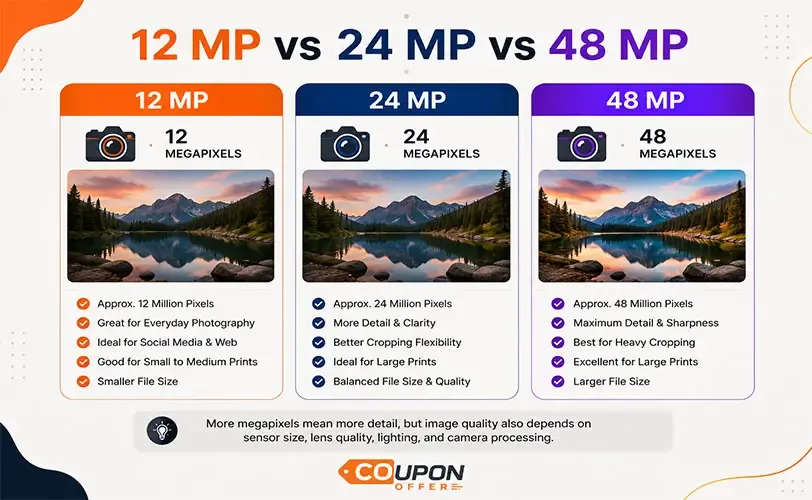
Megapixel comparisons are useful, but they need context.
Higher resolution provides more pixels, but it does not automatically guarantee better photographs. For many photographers, 12 MP is already enough resolution. Moving to 24 MP or higher becomes more valuable when you specifically need additional cropping or printing flexibility.
What Matters More Than Megapixels?
When considering the purchase of a camera, do not only consider the number of megapixels.
Sensor Size
The size of the sensor can significantly affect the quality of the image. The larger the sensor, the better it can perform, which may include:
- Low-light performance
- Dynamic range
- Depth-of-field control
- Noise performance
Sometimes, a higher-megapixel camera that has a tiny sensor can be outdone by a camera with a larger, well-designed sensor.
Lens Quality
The lens is responsible for the amount of detail and light that reaches the sensor. The sensor and the lens may not provide you with the amount of detail you would expect. If there's one thing more valuable than the megapixel count for many photographers, it's a quality lens.
Autofocus
To take sharp photos a camera must focalize properly. When capturing portraits of people, animals, sports or other subjects in motion, modern auto-focus systems can make a huge impact.
Dynamic Range
Dynamic range is the capacity of a camera to capture details in bright and dark parts of a scene. For landscapes and high contrast situations, a camera with a high dynamic range will preserve more detail in the brightest parts as well as the darkest parts.
Image Stabilization
Camera motion can cause blur, which may be minimized with image stabilisation. This is particularly useful at longer focal lengths and in low light situations when shooting handheld.
Image Processing
The image processing algorithms and the camera's processor affect the color, noise reduction, autofocus performance, JPEG quality and more of the final image.
Is 12 MP Good for Video?
In many video applications, there is no need to shoot 12 MP. This is because many modern still-image sensors have resolutions that are significantly higher than the common video resolutions. For example:
- The approximate amount of frames per picture for Full HD is 2 MP/frame.
- The 4K UHD requires about 8.3 MP per frame.
So, in the simplest terms, a 12 MP sensor can offer enough resolution for capturing 4K video.
But megapixels are not the only factor that determine video quality.
Other considerations like sensor readout, dynamic range, autofocus, stabilization, frame rates, codecs, overheating and lens options are more significant. When picking a camera for video purposes, don't base your decision on its still-image resolution.
Can a 12 MP Camera Take Professional Photos?
Yes. The number of megapixels is not the only measure of professional image quality. With good exposure, focus, lighting and a high-quality lens, a 12 MP camera can deliver professional photographs. The final application of the image counts, too.
If you're posting the image to a website, social media profile, magazine page, or digital ad, 12 MP might be adequate. Personally, professional photographers should look at the whole camera system and not just see megapixels as an indicator of camera quality.
Should You Buy a 12 MP Camera?
A 12 MP camera can be a good choice if you prioritize practical performance over maximum resolution. It may be suitable if you:
- Mainly share photos online
- Take family or travel photographs
- Photograph events
- Create social media content
- Shoot video
- Want manageable file sizes
- Don't frequently make huge prints
- Don't need extreme cropping flexibility
A higher-resolution camera may be a better fit if you:
- Frequently crop heavily
- Produce very large prints
- Photograph distant wildlife
- Create highly detailed commercial images
- Need maximum editing flexibility
The best choice depends on your photography needs.
How to Choose a Camera Beyond Megapixels
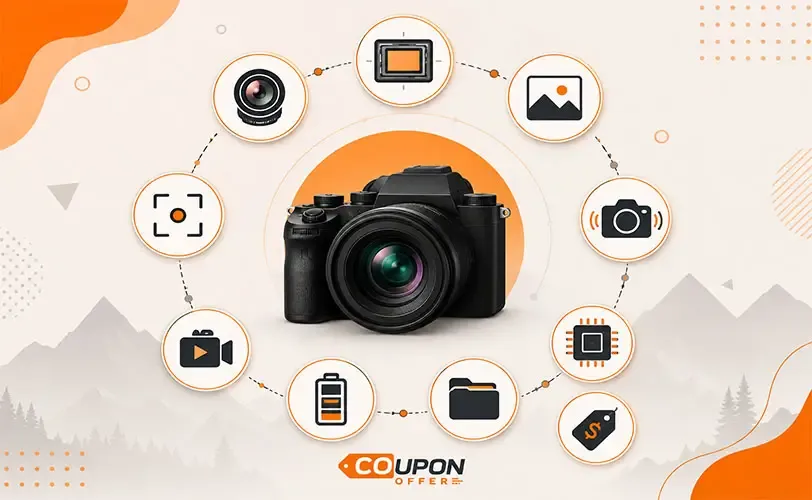
When comparing cameras, create a checklist based on your actual photography rather than simply looking for the largest number.
Consider:
- Sensor size— Does it suit your low-light and depth-of-field requirements?
- Lens ecosystem— Are suitable lenses available?
- Autofocus— Can it track the subjects you photograph?
- Stabilization— Is image stabilization important for your shooting style?
- Video features— What resolution, frame rates, and recording options do you need?
- Dynamic range— Does the camera perform well in high-contrast scenes?
- Ergonomics— Is it comfortable to use?
- File sizes— Can your storage and computer handle the camera's files?
- Price— Does the overall system fit your budget?
- Actual output— Do you need more resolution for your final photographs?
For example, photographers comparing full-frame and APS-C mirrorless systems can look at models such as the Sony Alpha A7 III, Nikon Z6 II, or Canon EOS R6 and evaluate the entire feature set rather than focusing only on resolution.
Is More Megapixels Always Better?
No, more megapixels doesn't necessarily mean a larger file, more storage space or high processing power. In addition, higher resolution also reveals camera shake, focus errors, lens restrictions and poor technique more clearly when looking at the images at high magnification.
It is, therefore, imperative to choose the best possible resolution for the purpose for which the camera will be used. If you're a photographer who primarily shoots online, it might be more crucial that the photos have an auto-focus, high quality lens, stabilization, and colour to them. This additional resolution can be very useful for those photographers who routinely crop their images aggressively as wildlife images.
Final Words
Overall, 12 MP is enough for most everyday, social media, portrait, travel, and web photography. Image quality depends on much more than megapixel count, including sensor size, lens quality, autofocus, dynamic range, and image processing. However, photographers who need extensive cropping, very large prints, or highly detailed commercial work may benefit from a higher-resolution camera. Ultimately, choose a camera based on your specific photography needs rather than megapixels alone.
Common Questions About 12 MP Cameras
Is a 12 MP camera good for photography?
Yes. A 12 MP camera can produce excellent photographs for everyday use, social media, websites, moderate-size prints, and many professional applications.
Is 12 MP enough for a beginner?
Yes. For most beginners, 12 MP provides enough resolution to learn photography without dealing with unnecessarily large files.
Is 12 MP enough for Instagram?
Yes. A 12 MP camera provides plenty of resolution for social media photography. The platform's processing and resizing mean that extremely high megapixel counts are usually unnecessary.
Is 12 MP enough for 4K video?
Yes, in terms of basic pixel count. 4K UHD requires approximately 8.3 million pixels per frame, although actual video quality depends on sensor readout, processing, lens quality, stabilization, and other features.
Is 12 MP enough for professional photography?
It can be. Many professional applications do not require extremely high resolution. However, commercial photographers, fine-art photographers, and photographers who crop heavily may benefit from higher-resolution cameras.
Is 24 MP noticeably better than 12 MP?
It provides twice the number of pixels, which can offer more cropping and printing flexibility. However, it does not automatically mean photographs will look twice as good.
Is 12 MP good for wildlife photography?
It can be, particularly when the subject fills much of the frame. However, wildlife photographers who regularly crop distant subjects may benefit from higher resolution.
Can you print large photos from a 12 MP camera?
Yes. A 12 MP photograph can produce quality prints, although the maximum practical size depends on the image quality, viewing distance, print resolution, and intended use.
Does megapixel count affect low-light performance?
It can interact with sensor design, but megapixels alone do not determine low-light performance. Sensor size, pixel architecture, lens aperture, image processing, and stabilization also matter.
Should I choose a 12 MP camera over a 24 MP camera?
Choose based on your needs. If you primarily shoot for online use, everyday photography, or video, 12 MP may be sufficient. If you frequently crop, print large images, or need more editing flexibility, 24 MP may be preferable.
Is a 12 MP Camera Good?
Yes, a 12 MP camera can be very good. For everyday photography, social media, websites, family photos, travel, video, and many professional applications, 12 MP provides plenty of resolution.
The biggest mistake is judging a camera solely by its megapixel count.
Sensor size, lens quality, autofocus, dynamic range, stabilization, image processing, and shooting conditions can have a major impact on the final photograph.
If you need to crop heavily or create very large, highly detailed prints, a 24 MP or higher-resolution camera may offer more flexibility. But if your main goal is producing high-quality images for everyday and digital use, there is no need to assume that 12 MP is inadequate.
When comparing cameras, focus on the complete system and how it matches your photography needs—not simply the largest megapixel number.
You can read more blogs about:
 Share On Twitter