



How Do Cameras Capture Images? Science & Mechanism
It seems effortless and instantaneous to take a picture. You hit a button and the image comes to the screen. But within the device, a very complicated process occurs in less than a second. A digital camera is a camera that records a scene using glass parts, electrical signals, and computer chips. No matter whether you're employing a smartphone or a professional setup, knowing how this works makes much better technical decisions. Check out our wide range of modern cameras and choose the best camera body for your creative process.
The basic physical process involved in capturing an image is the control, focusing and recording of light, just about that. There are several key hardware elements that play nicely together from the time light bounces off a subject through the time a digital file lands on your memory card.
1. The Role of Light: The Foundation of Image Creation
At its core, a camera does not record physical objects—it records ambient light bouncing off physical objects. Without light, photography cannot exist.
When light hits a subject in your scene, light rays scatter in every direction. The camera’s job is to gather those chaotic rays, bend them through a lens, and focus them onto a single flat plane (the image sensor or physical film).
2. Lens Optics: Bending and Focusing Light Rays
Light will pass through the lens assembly before reaching the internal recorder. A camera lens is composed of multiple elements of either glass or ceramic, each performing a function to improve the incoming light:
- Refraction: When the light enters the glass it slows down and bends. The precise convex and concave curves of lens elements focus scattered light rays to a convergence point (the focal point).
- Focal length: It is distinguished by the distance in millimeters between the lens and the image captured (e.g. 24mm, 50mm, 200mm) and it is the angle of view and optical magnification that you are getting. A short focal length will capture a large scene, and a longer focal length will focus on a distant subject.
- Focusing Mechanisms: They shift the internal glass elements forward or backwards to bring your subject to the exact plane of the sensor, and then sharp.
3. Controlling Light: The Exposure Triangle
The camera uses three basic parameters to achieve a balanced exposure, a pitch black image (underexposed) or a blown-out white image (overexposed):
- Aperture (Physical Light Volume): Within the lens, an iris comprising of overlapping blades creates a variable aperture or opening, the shape of which is circular. It is measured in "f-stops" (f/1.4, f/2.8, f/8, etc.) and determines the amount of light that can enter the camera body. Narrow apertures (f/8 – f/16) let less light in, reduce background blur (bokeh) and make the entire scene sharp; wide apertures (f/1.4 – f/2.8) let in more light, create background blur (bokeh) and will keep the whole scene from being sharp.
- Situated directly in front of the sensor, the shutter creates a fine curtain. It affects the duration of the light exposure on the surface being recorded. Fast shutter speeds (1/2000s) freeze fast action and slow shutter speeds (1/2s or several seconds) will allow motion blur.
- ISO (Electronic Signal Gain): The ISO is a measurement of the sensitivity of the sensor to light. Lower numbers (ISO 100) produce a clearer image, whereas higher numbers (ISO 6400 and higher) will amplify weak signals, which will add digital noise or grain to the image.
4. Optical vs. Electronic Shutters
As light goes through the lens and the aperture, the exposure time is measured by the shutter curtain. There are two major ways of exposing the sensor in modern digital systems:
- Focal-Plane Mechanical Shutters: These mechanical shutters move across the sensor face opening and closing in a fraction of a millisecond.
- Electronic Shutters: The sensor is an electronic shutter that turns the light pixels on and off, which means that any shot is completely silent, with extremely fast shutter speeds.
For more information on the internal mechanical structures and contemporary sensor sets, see our guide to do mirrorless cameras have a shutter.
5. Converting Light into Pixels: Sensor Technology
After the light goes through the shutter, it enters the core of the digital system, the image sensor. Modern digital cameras employ a large number of light buckets, called photosites or pixels, which are microscopic units of silicon in the form of a CCD (Charge-Coupled Device) or a CMOS (Complementary Metal-Oxide-Semiconductor) sensor.
- Photon Capture: When photons (light particles) hit each photosite a small electrical charge is created. The more light that falls on a photosite, the greater the voltage that is produced.
- The Bayer Pattern: Image sensors are a color blind device, they only measure light intensity. When creating color images, a Bayer filter matrix overlying each pixel divides incoming light into Red, Green and Blue (RGB) filters.
- Demosaicing: The camera's internal image processor uses the RGB voltage values measured between neighbouring pixels to determine accurate colour and brightness values for each individual pixel in your image.
6. Image Processing and File Formats
Once the electrical voltage between millions of pixels is measured, the sensor passes the raw electrical measurement to an Analog-to-Digital Converter (ADC) which converts the raw electrical value into binary code (1s and 0s). The camera's picture processor turns the data into two primary formats:
- RAW Files: Raw data that is saved directly from the sensor. RAW files contain maximum dynamic range, giving photographers tremendous latitude during editing.
- JPEG / HEIF Files: Compressed files that are processed right in the camera. The processor automatically sharpens, increases contrast, saturates colors and reduces noise, resulting in a file that is ready for sharing with a smaller footprint.
7. Analog vs. Digital Image Capture
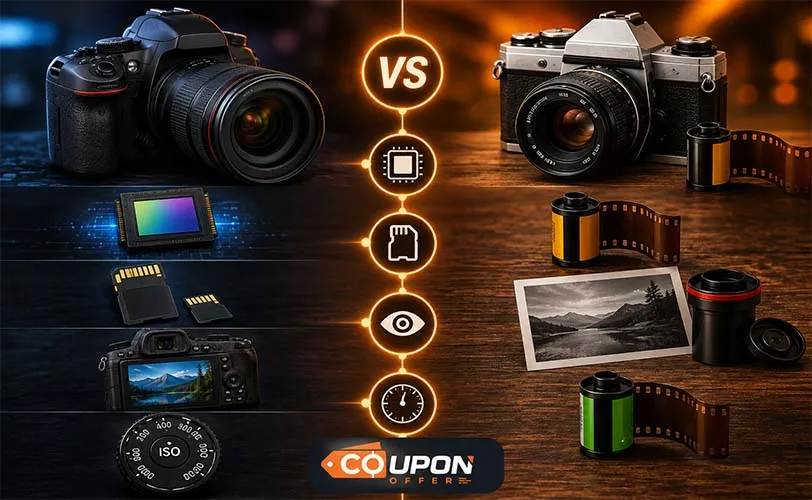
While digital sensors dominate the modern market, classic film photography relies on chemical reactions instead of digital sensors:
Understanding traditional photographic mechanisms also adds real clarity if you collect or trade older photographic equipment. If you are curious about historical gear, read our deep dive into who buys vintage cameras.
Choosing the Right Body for High-Quality Capture
Different camera types use varying sensor sizes and processing engines to record images. Full-frame sensors offer maximum light-gathering capacity and dynamic range, while APS-C sensors keep bodies lightweight and versatile.
If you are looking for an ultra-fast APS-C setup featuring advanced AI tracking autofocus and robust 4K video recording, check out this versatile hybrid camera to elevate your photography.
Alternatively, if you prefer high-speed continuous shooting rates alongside superb color rendition for sports and wildlife, take a look at this high-performance crop-sensor camera for your next shooting session.
To find out some mirrorless options, check out our products for mirrorless cameras.
Summary: The Step-by-Step Capture Process
- Light Reflection: Light bounces off your subject toward the lens.
- Optical Focus: Lens elements refract and focus light rays onto the focal plane.
- Aperture Regulation: The lens iris controls the physical volume of light passing through.
- Shutter Exposure: The shutter opens for a set duration, letting light strike the sensor.
- Photoelectric Conversion: Sensor photosites turn photons into electrical signals.
- Color Calculation: The Bayer array and processor calculate precise RGB pixel colors.
- File Saving: Data converts into binary code and saves as a RAW or JPEG image file.
Next time you press the shutter button, you can appreciate the intricate physics and engineering happening inside your gear in a fraction of a second. To find great deals on modern cameras, lenses, and photo accessories, browse our full inventory at Coupon Offer.
Conclusion
Looking at a picture takes no time at all, but the actual process is quite an optical, mechanical and electronic feat. Every second, from the time the light reflects off the subject and refracts through the lens elements, through the time that the exposure triangle is used to control it, up until the time that the binary signals are formed by the sensor, is full of complex engineering.
For a more detailed look into the physical-to-electronic transformation of light by digital sensors, see the complete Semiconductor Engineering Sensor Guide. The fundamentals of photography you learn, whether taking photos with a smartphone, a classic film body or a modern mirrorless system, ultimately put you in full control of your photography.
Frequently Asked Questions
What happens in a camera when you push the shutter button?
When you press shutter button, the exposure calculation is done, the lens is focused, the mechanical curtains are raised (or the electronic sensor is turned on), the photons of light are captured by the sensor pixels, the electrical voltage is translated into digital code, and the image file is stored on the memory card.
How does larger sensor size improve photos in low light?
The larger the image sensor, the larger the photosites (pixels). In low-light conditions, larger pixels can collect many more photons, and therefore provide much clearer images with little digital noise.
What is the difference between zooming with optical and digital zoom?
In optical zoom, the zoom mechanism works by moving the glass parts inside the lens to zoom in or out of a scene without compromising the resolution. Digital zoom magnifies the image from the sensor, but does not increase the sensor's area. This causes the image to appear blurry and soft.
What are the principles of an automatic focusing system in a camera?
Today's digital cameras feature a phase detection or contrast detection system in the image sensor. Phase detection is used to measure distance quickly as a comparison of incoming light rays is made, and contrast detection adjusts focus for maximum sharpness based on the contrast of the pixels.
What is the color blindness of an image sensor?
Yes. Sensor pixels cannot measure anything else but the intensity (brightness) of the light photons that strike them. A color filter array (typically a Bayer filter pattern) lies between the sensor and the light to direct the light into the Red, Green, and Blue wavelengths.
What is ISO in digital photography?
ISO refers to signal amplification. Raising ISO boosts the electrical signal generated by photosites, allowing you to capture brighter images in low light at the cost of added digital noise.
Can a camera capture images without a physical lens?
Yes, a pinhole camera captures images without glass optics by forcing light through a tiny pinhole aperture. However, optical glass lenses produce vastly sharper, brighter images by focusing light rays precisely onto the sensor plane.
 Share On Twitter