


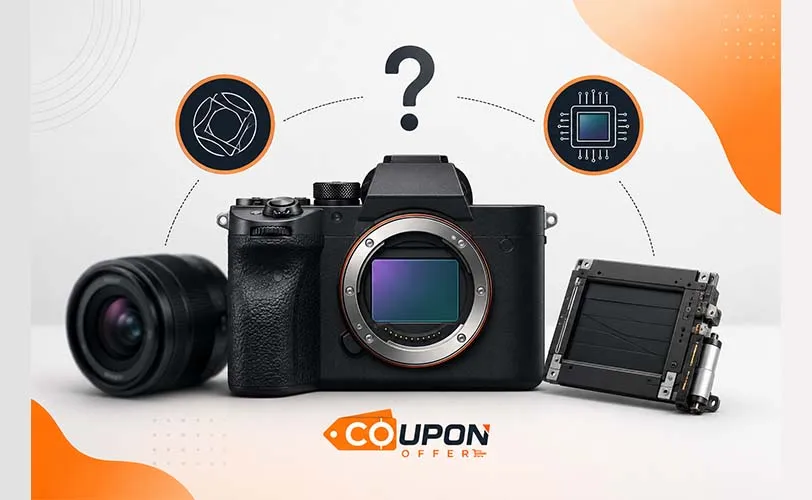

Do Mirrorless Cameras Have a Shutter? Complete Guide
If you are new to mirrorless photography, you may wonder: do mirrorless cameras have a shutter? The short answer is yes, many mirrorless cameras have a shutter system, but it may be mechanical, electronic, or a combination of both. If you're exploring different camera options, you can also browse CouponOffer's camera category to compare available camera products.
The term mirrorless refers to the absence of the reflex mirror found in DSLR cameras. It does not mean that the camera has no shutter. In fact, many popular mirrorless cameras, including models from Canon and Nikon, offer multiple shutter modes.
Understanding the difference between these shutter types is important because each can behave differently when you photograph moving subjects, use flash, shoot silently, or work under artificial lighting.
What Does a Camera Shutter Do?
A camera shutter controls how long the image sensor is exposed to light when you take a photograph. This duration is represented by shutter speed. A fast shutter speed such as 1/1000 second exposes the sensor for a very short time, which can help freeze movement. A slower setting such as 1 second keeps the exposure active longer and can produce motion blur.
In a traditional mechanical shutter, physical curtains move to control the exposure. In an electronic shutter, the camera uses the sensor's electronic readout instead of relying on physical curtains for the exposure. The shutter is therefore an exposure-control system, not something that exists only in DSLR cameras.
Why Are Mirrorless Cameras Called “Mirrorless”?
The name comes from the camera's optical design. A DSLR uses a reflex mirror between the lens and the imaging sensor. Light entering through the lens is reflected toward the optical viewfinder. When you take a picture, the mirror moves out of the way so light can reach the sensor.
A mirrorless camera removes this reflex mirror. The image sensor receives light directly, and the camera can use an electronic viewfinder or rear display to show the scene. That means two separate concepts are involved:
- Mirror: directs light to a DSLR's optical viewfinder.
- Shutter: controls the sensor's exposure.
Removing the first does not automatically remove the second.
What Types of Shutters Do Mirrorless Cameras Have?
Mirrorless cameras can use several shutter configurations. The exact options depend on the camera model.
Mechanical Shutter
A mechanical shutter uses physical curtains to control exposure. In a conventional focal-plane design, one curtain starts the exposure, and another ends it. The curtains move across the sensor at very precise speeds.
Many mirrorless cameras still use this system. The Nikon Z6 II, for example, has a mechanical shutter system and supports shutter speeds up to 1/8000 second.
Mechanical shutters are useful because they provide predictable results in many shooting conditions, including situations involving flash or artificial lighting.
However, because physical components move, mechanical shutters produce some noise and can experience mechanical wear over many actuations.
Electronic Shutter
An electronic shutter works differently. Instead of physically opening and closing the shutter curtains for the exposure, the camera controls exposure through the sensor electronically.
One major benefit is silent shooting. There is no need for the same physical curtain movement during an electronic exposure, which can be useful when photographing wildlife, weddings, performances, or other situations where camera noise could be distracting.
Electronic shutters can also allow very fast shutter speeds. Some modern mirrorless cameras are designed around high-speed electronic shooting. However, electronic shutters can introduce problems such as rolling-shutter distortion or banding under some artificial lights.
Electronic Front-Curtain Shutter
An electronic front-curtain shutter, often abbreviated as EFCS, combines electronic and mechanical operation. Instead of using a physical front curtain to begin exposure, the camera starts the exposure electronically. A mechanical rear curtain can then complete the exposure.
This approach can reduce mechanical movement and shutter noise while retaining some characteristics of mechanical shutter operation. The Nikon Z50 II, for example, offers mechanical, electronic front-curtain, and electronic shutter options.
Mechanical vs Electronic Shutter
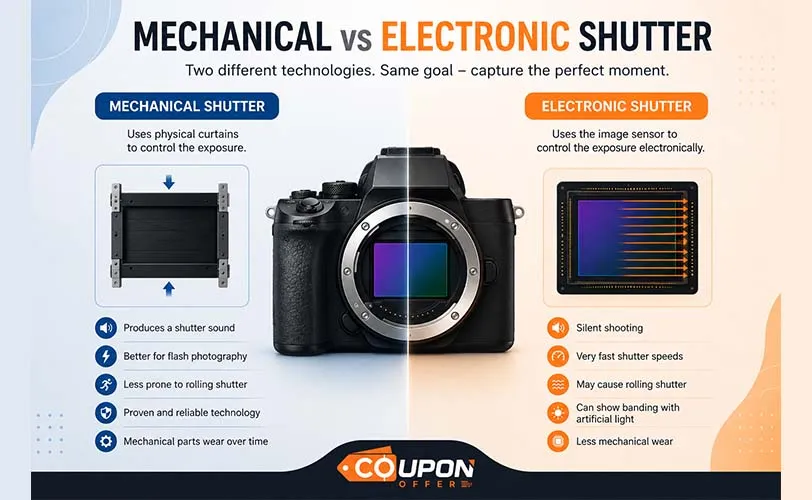
The main difference is how the camera begins and ends the exposure.
The exact capabilities vary by camera, so this table should be treated as a general guide rather than a specification for every mirrorless model.
Do Mirrorless Cameras Always Have a Mechanical Shutter?
No. This is one of the most important points to understand. Many mirrorless cameras have mechanical shutters, but some newer models can operate with electronic shutters only. Canon, for example, has introduced mirrorless models that use an electronic shutter without a mechanical shutter. The EOS R6 V is specified with an electronic shutter only and no mechanical shutter.
So if you are choosing a camera, don't assume that “mirrorless” automatically means it has both types. Check the manufacturer's specifications for the exact model.
How Does an Electronic Shutter Work?
An electronic shutter uses the image sensor itself to control when the exposure is recorded. With many CMOS sensors, the image is read progressively rather than captured by every pixel at precisely the same instant. This is commonly associated with a rolling shutter.
For ordinary subjects, this may not be noticeable. But if something moves quickly during the sensor readout, parts of the subject can be recorded at slightly different moments.
This can result in distortion. For example, a rapidly rotating object may appear bent, or a vertical object may appear tilted when the camera is panned quickly.
The severity depends on the camera's sensor technology and readout speed. Modern cameras can significantly reduce these effects by using faster sensor readout. This is one reason that electronic-shutter performance can differ dramatically between mirrorless cameras.
What Is Rolling Shutter?
Rolling shutter occurs when different parts of the image sensor are recorded at different times. Imagine photographing a fast-moving car from left to right. If the top portion of the sensor records the car slightly before the bottom portion, the car may not appear in the same position across the entire frame. Possible results include:
- Slanted vertical lines
- Distorted vehicles
- Bent rotating objects
- Unnatural shapes during fast panning
Rolling shutter is particularly relevant when using electronic shutter modes. However, it should not be interpreted as meaning that electronic shutters are unsuitable for action photography.
Some high-end mirrorless cameras have very fast sensor readout and are specifically designed for high-speed electronic shooting. The important factor is the specific camera, not simply whether it uses an electronic shutter.
When Should You Use a Mechanical Shutter?
A mechanical shutter can be useful when you want predictable results in challenging shooting conditions.
Fast-Moving Subjects
If your camera has relatively slow electronic sensor readout, a mechanical shutter may help reduce rolling-shutter distortion when photographing fast movement. This can be useful for:
- Sports
- Motorsports
- Moving vehicles
- Fast wildlife
- Rapid camera panning
However, advanced mirrorless cameras can perform extremely well with electronic shutters, so this isn't an absolute rule.
Flash Photography
Flash compatibility is another reason to use a mechanical shutter. Some cameras restrict flash when electronic shutter mode is selected. Canon's EOS R6, for example, specifies that its electronic shutter cannot be used with flash photography.
Therefore, if you regularly use an external flash, check your camera's shutter and flash specifications before selecting a mode.
Flickering Artificial Light
Electronic shutters can sometimes interact with flickering LED, fluorescent, or other artificial light sources. This can create horizontal bands or differences in brightness across the image.
Canon documents this possibility for electronic shutter shooting on the EOS R6 and recommends considering the limitations when working with flickering light sources.
When Should You Use an Electronic Shutter?

Electronic shutter mode can be extremely useful in situations where silence or speed is important.
Wildlife Photography
A silent camera can be helpful when photographing animals that may react to mechanical shutter noise.
Weddings and Ceremonies
During quiet moments, electronic shutter operation can help minimize distractions.
Street Photography
Silent shooting can make photography less noticeable, although photographers should always respect privacy and local laws.
High-Speed Continuous Shooting
Some modern mirrorless cameras can achieve very high burst rates electronically. For example, Canon's EOS R6 Mark III supports up to 40 frames per second using its electronic shutter, while its mechanical/first-curtain modes have lower burst rates.
This illustrates why electronic shutters have become increasingly important in modern mirrorless cameras.
Does an Electronic Shutter Make a Camera Completely Silent?
Not necessarily. Electronic shutter operation can eliminate the physical sound of mechanical shutter curtains, but a camera may still produce other sounds. For example, focusing motors, aperture mechanisms, image stabilization components, or electronic confirmation sounds can still be audible. Some cameras also offer simulated shutter sounds for user feedback.
Canon notes that its EOS R6's electronic shutter does not generate a shutter-release sound, although other sounds from the camera may still be present. So “silent shutter” generally means that the camera can take the photograph without the normal mechanical shutter sound, not that every component becomes completely silent.
Does a Mechanical Shutter Wear Out?
A mechanical shutter contains moving parts, so it can experience wear over time. Camera manufacturers often provide a shutter durability figure for certain models. This is generally based on testing rather than a guarantee that every individual shutter will fail at a particular number of photographs.
For example, Canon states that the EOS R6 Mark III's mechanical shutter has been tested to 500,000 exposures. Using an electronic shutter can reduce mechanical shutter actuations because the physical curtains are not performing the same exposure operation.
However, shutter count is only one aspect of camera longevity. Sensor condition, buttons, batteries, image stabilization systems, connectors, and other components can also experience wear.
Is Electronic Shutter Better Than Mechanical Shutter?
Neither is universally better. The right option depends on what you are photographing.
The camera's individual specifications should always take priority over general rules.
How Does Shutter Speed Work on a Mirrorless Camera?
Whether the shutter is mechanical or electronic, shutter speed controls exposure duration. Common examples include:
- 1/1000 sec: Useful for freezing fast movement
- 1/500 sec: Suitable for many action scenes
- 1/250 sec: Common for general photography
- 1/60 sec: Useful for relatively stationary subjects
- 1 second: Creates significant motion blur
Shutter speed works together with aperture and ISO to determine exposure. A faster shutter speed generally allows less light to reach the sensor, while a slower shutter speed allows more light.
Electronic shutter technology does not change this basic photographic principle. It changes how the camera controls the exposure.
What Should You Check Before Buying a Mirrorless Camera?
If you are researching a camera, don't stop at the question of whether it has a shutter. Consider the following specifications.
Shutter Types
Check whether the camera offers:
- Mechanical shutter
- Electronic shutter
- Electronic front-curtain shutter
- Silent shooting
Maximum Shutter Speed
A higher maximum shutter speed can be useful for action photography and shooting wide apertures in bright conditions.
Electronic Shutter Performance
Look for information about:
- Sensor readout speed
- Rolling-shutter performance
- Maximum electronic shutter speed
- Continuous shooting speed
Flash Compatibility
If you use flash, check the camera's sync speed and whether flash is supported in electronic shutter modes.
For example, the Nikon Z50 II supports flash synchronization at specified shutter speeds and also provides electronic shutter operation.
Shutter Durability
If you take a very large number of photographs, a manufacturer's mechanical shutter durability specification can be useful when comparing cameras.
Mirrorless Cameras You Can Compare
If you're researching mirrorless cameras, the camera models listed on CouponOffer can provide a starting point for product research.
For example, you can look at the Sony Alpha A7 III, Nikon Z6 II, Nikon Z50 II, Nikon Z5 II, Canon EOS R6, Canon EOS R5, Canon EOS R7, and Canon EOS R10.
When comparing them specifically for shutter behavior, however, use the manufacturer's current specifications because features can differ between models and firmware versions.
Common Misconceptions About Mirrorless Camera Shutters
“Mirrorless Means No Shutter”
False. Mirrorless describes the lack of a reflex mirror, not the lack of a shutter.
“Every Mirrorless Camera Has a Mechanical Shutter”
False. Some mirrorless cameras use electronic shutters only. Canon's EOS R6 V is one current example.
“Electronic Shutter Is Always Better”
Not necessarily. It can be excellent for silent shooting and fast bursts, but rolling shutter, artificial-light banding, and flash limitations can make mechanical operation preferable.
“Mechanical Shutters Are Outdated”
Not necessarily. Mechanical shutters remain useful for many photographic situations, particularly flash photography and certain lighting environments.
“Silent Shooting Means Absolutely No Sound”
Not always. Electronic shutter operation can eliminate mechanical shutter noise, but lenses, aperture mechanisms, focusing systems, or artificial camera sounds may still produce sound.
Frequently Asked Questions
Do mirrorless cameras have a shutter?
Yes. Many mirrorless cameras have mechanical, electronic, or electronic front-curtain shutters. Some newer models use electronic shutters without a mechanical shutter.
Do mirrorless cameras need a mechanical shutter?
No. A mirrorless camera can capture photographs electronically. However, mechanical shutters remain useful for flash, certain lighting conditions, and situations where rolling-shutter distortion is a concern.
Do all mirrorless cameras have both mechanical and electronic shutters?
No. Shutter configurations vary by model. Some cameras offer all three common options, while others may use only electronic shutter technology.
Are mirrorless cameras silent?
They can be. Electronic shutter modes can provide silent shooting, although other camera sounds may still occur.
Is electronic shutter good for sports?
It can be excellent if the camera has fast sensor readout. High-end mirrorless cameras can use electronic shutters for very high burst rates. However, slower-readout sensors may produce rolling-shutter distortion with fast action.
Can electronic shutters work with flash?
It depends on the camera. Some models restrict flash while using electronic shutter mode. Always check the manufacturer's specifications for the exact camera.
What is an electronic front-curtain shutter?
It is a hybrid shutter mode in which the exposure begins electronically rather than with a physical front curtain. A mechanical rear curtain may still finish the exposure.
Does an electronic shutter increase camera lifespan?
It can reduce mechanical shutter actuations because physical curtains do not perform the same exposure operation. However, it does not eliminate wear from other camera components.
Which shutter should beginners use?
For general photography, either a mechanical or electronic shutter can work well. If you are unsure, a mechanical shutter is often a straightforward starting point because it avoids some of the potential issues associated with electronic shutter operation. As you become familiar with your camera, you can use an electronic shutter when silence or high-speed shooting is beneficial.
Do Mirrorless Cameras Have a Shutter? Final Answer
So, do mirrorless cameras have a shutter? Yes, many do but the answer is more nuanced than it may initially appear. A mirrorless camera can use a mechanical shutter, electronic shutter, electronic front-curtain shutter, or a combination of these technologies. The absence of a mirror does not mean the absence of a shutter.
If you're comparing mirrorless cameras, focus not only on megapixels or autofocus specifications but also on shutter types, electronic-shutter performance, flash compatibility, maximum shutter speed, and rolling-shutter behavior. These details can make a meaningful difference in how a camera performs in real-world photography.
 Share On Twitter