



Different Types of Digital Cameras: Complete Guide for Beginners
If you're shopping for a camera, understanding the different types of digital cameras can make the decision much easier. Digital cameras range from simple compact models designed for convenience to interchangeable-lens cameras built for advanced photography.
Each type has different strengths in image quality, portability, controls, lens flexibility, and video performance. The right camera depends on what you photograph, how much control you want, and how often you plan to carry it. This guide explains the major types of digital cameras and what each one is best suited for.
What Are the Different Types of Digital Cameras?
Digital cameras fall into several major categories based on their design, lens system, sensor, and intended use.
The most common types include:
- Compact digital cameras
- Bridge cameras
- DSLR cameras
- Mirrorless cameras
- Action cameras
- Instant digital cameras
- Medium-format digital cameras
- Specialty and rugged cameras
- Smartphone cameras
While smartphones technically use digital camera systems, they are usually discussed separately from dedicated digital cameras. For shoppers exploring camera equipment, CouponOffer can also help compare available products and find deals. You can check how do cameras take images too.
Digital Camera Types at a Glance
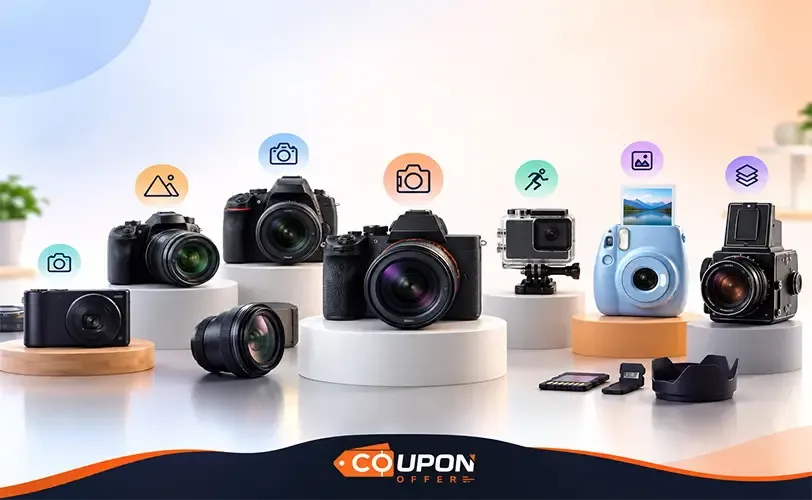
This quick overview compares the main digital camera types by their features, strengths, portability, and ideal photography uses.
The categories can overlap, and camera capabilities vary significantly between individual models.
1. Compact Digital Cameras
Compact cameras, sometimes called point-and-shoot cameras, are designed primarily for convenience.
They typically have a built-in lens, automatic shooting modes, and a relatively small body. The user can turn the camera on, frame the subject, and take a photograph without needing to adjust numerous settings.
Advantages of Compact Cameras
- Small and lightweight
- Easy to operate
- Built-in lens
- Convenient for travel
- Quick to use
- Usually less complicated than interchangeable-lens cameras
Disadvantages
- Limited lens flexibility
- Smaller sensors in many models
- Less control than advanced cameras
- Some models offer limited low-light performance
Compact cameras can be a good choice for people who want a dedicated camera without carrying a large photography setup.
2. Bridge Cameras
Bridge cameras sit between compact cameras and interchangeable-lens cameras. They usually have a fixed lens with a large optical zoom range, allowing photographers to photograph everything from relatively wide scenes to distant subjects without changing lenses.
This makes them particularly attractive for travel, wildlife viewing, and general-purpose photography.
Advantages of Bridge Cameras
- Large zoom range
- No need to buy multiple lenses
- Convenient all-in-one design
- More manual controls than basic compact cameras
- Useful for travel
Limitations
The main limitation is that the lens cannot normally be removed and replaced with another lens. Sensor sizes also vary, and many bridge cameras use smaller sensors than advanced mirrorless or DSLR cameras.
Bridge cameras are therefore a useful compromise for photographers who value zoom flexibility and convenience.
3. DSLR Cameras
DSLR stands for Digital Single-Lens Reflex. DSLR cameras use a mirror mechanism and optical viewfinder system. Light entering through the lens is reflected by a mirror toward the optical viewfinder. When you take a photograph, the mirror moves to allow light to reach the image sensor. One of the biggest advantages of a DSLR is its interchangeable-lens system.
Advantages of DSLR Cameras
- Interchangeable lenses
- Optical viewfinder
- Excellent image quality
- Strong manual controls
- Wide selection of lenses and accessories
- Long battery life on many models
- Established ecosystem of equipment
DSLRs have traditionally been popular among enthusiasts and professionals.
Disadvantages of DSLR Cameras
- Larger and heavier bodies
- Mirror mechanism adds complexity
- Large lenses can make a complete system bulky
- Electronic features may be less advanced than newer mirrorless models
DSLRs remain capable photography tools even though mirrorless cameras have become increasingly popular.
4. Mirrorless Cameras
Mirrorless cameras are interchangeable-lens cameras that do not use the DSLR-style reflex mirror system. Instead, light reaches the image sensor directly. The photographer generally composes images using an electronic viewfinder, rear display, or both.
Mirrorless cameras are available across a wide range of prices and sensor formats. For example, cameras such as the Sony Alpha a7 III, Nikon Z 6II, and Canon EOS R6 demonstrate the variety available in the mirrorless category.
Advantages of Mirrorless Cameras
- No reflex mirror
- Often smaller than comparable DSLRs
- Electronic viewfinders can display exposure previews
- Excellent autofocus on many modern models
- Strong video capabilities
- Interchangeable lenses
- Wide selection of body sizes and sensor formats
Disadvantages
- Electronic viewfinder and display use battery power
- Some systems can become expensive with multiple lenses
- Ergonomics vary considerably between models
- Electronic systems may require a learning period for beginners
For photographers interested in both still photography and video, mirrorless cameras can offer a particularly flexible platform.
5. Action Cameras
Action cameras are designed for situations where a conventional camera may be inconvenient or vulnerable.
They are generally small, lightweight, and built to withstand movement and challenging environments. Many models can be mounted to helmets, bicycles, vehicles, tripods, and other equipment.
Common Uses
Action cameras are popular for:
- Cycling
- Hiking
- Skiing
- Surfing
- Motorcycling
- Travel
- Outdoor sports
- Underwater activities
Their compact size makes them easy to carry, while wide-angle lenses are useful for capturing immersive footage. The trade-off is that their small sensors and fixed lenses may provide less control and image quality than larger interchangeable-lens cameras in demanding conditions.
6. Instant Digital Cameras
Instant cameras combine digital technology with the concept of immediate physical prints. Some modern models capture images digitally and can also produce physical photographs. They are designed more around creativity, convenience, and sharing than maximum image quality.
Why People Choose Them
- Fun shooting experience
- Physical photographs
- Simple operation
- Social and creative use
- Compact designs
They are particularly suitable for parties, events, travel memories, and casual photography.
7. Medium-Format Digital Cameras
Medium-format cameras use image sensors larger than the traditional full-frame format. They are generally designed for photographers who prioritize extremely high image quality, resolution, tonal detail, and large-format output.
Common Applications
Medium-format systems are often used for:
- Commercial photography
- Fashion
- Advertising
- Studio photography
- Fine-art photography
- High-end portraits
- Large prints
The disadvantages are typically higher costs, larger equipment, and more demanding workflows. For everyday photography, a medium-format system is usually unnecessary. But for specialized professional work, its image-quality advantages can be valuable.
8. Rugged and Waterproof Digital Cameras
Rugged cameras are designed for environments where conventional cameras may be at greater risk of damage. Depending on the model, they may offer protection against:
- Water
- Dust
- Shock
- Freezing temperatures
- Accidental drops
They can be useful for hiking, snorkeling, camping, travel, and other outdoor activities. The exact level of protection varies by model, so photographers should always check the manufacturer's specifications before exposing a camera to water or extreme conditions.
9. Specialty Digital Cameras
Some digital cameras are designed for specific purposes rather than general photography. Examples include cameras optimized for:
- Wildlife observation
- Scientific imaging
- Industrial inspection
- Astrophotography
- 360-degree photography
- Vlogging
- Webcam use
- Underwater photography
For example, a dedicated webcam such as the Elgato Facecam 4K is designed around video communication and content creation rather than traditional interchangeable-lens photography.
Specialty cameras can make sense when a specific workflow requires features that a general-purpose camera does not provide.
Related: what does 4k mean for cameras?
DSLR vs Mirrorless: What's the Difference?
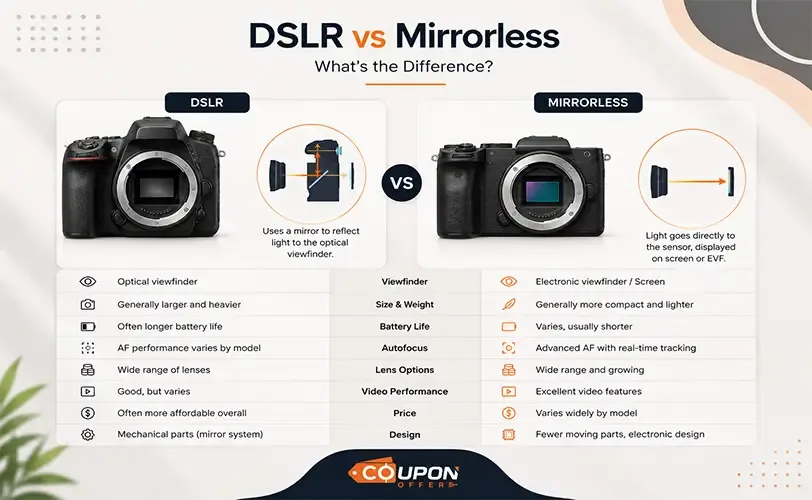
DSLR and mirrorless cameras are both interchangeable-lens systems, but their internal designs differ.
Neither category is automatically better for every photographer. The right choice depends on your preferred shooting style, budget, lens requirements, and desired features.
What Type of Digital Camera Is Best for Beginners?
There is no single best camera type for every beginner. Your choice should depend on how you plan to use the camera.
For Simple Everyday Photography
A compact camera can be a convenient choice if you want something small and easy to operate.
For Travel
A compact or bridge camera can be useful when portability and versatility are priorities.
For Learning Photography
A mirrorless or DSLR camera can be more appropriate if you want to learn manual exposure, interchangeable lenses, and advanced composition.
For Sports and Adventure
An action camera is useful when small size, mounting options, and durability matter.
For Professional Photography
A higher-end mirrorless, DSLR, or medium-format system may be appropriate depending on the type of work.
What Should You Consider Before Buying a Digital Camera?
Camera type is only the first decision. Several other specifications can significantly affect your experience.
Sensor Size
Sensor size influences image quality, depth of field, low-light performance, and field of view. Common formats include:
- Full frame
- APS-C
- Micro Four Thirds
- Medium format
- Smaller compact-camera sensors
A larger sensor does not automatically make every photograph better, but it can provide advantages in certain shooting situations.
Megapixels
Megapixels indicate the approximate resolution of the captured image. More megapixels can provide additional cropping and large-print flexibility, but megapixel count alone does not determine image quality. Sensor design, lens quality, image processing, lighting, and shooting technique all matter.
Lens System
If you choose an interchangeable-lens camera, investigate the available lens ecosystem before buying. Consider whether you will need:
- Wide-angle lenses
- Standard zooms
- Portrait lenses
- Telephoto lenses
- Macro lenses
- Fast-aperture lenses
The cost and availability of lenses can have a major impact on the overall cost of a camera system.
Autofocus
Modern autofocus systems can vary significantly. If you photograph sports, wildlife, children, or moving subjects, autofocus performance may be more important than having an extremely high megapixel count.
Video Features
If you plan to create video content, look at:
- Resolution
- Frame rates
- Autofocus during video
- Stabilization
- Microphone support
- Headphone monitoring
- Recording limits
- Heat management
A camera that is excellent for still photography may not necessarily be the best choice for video.
Size and Weight
A technically advanced camera is not useful if you rarely want to carry it. Think about where you will use it. A small mirrorless camera may be preferable for travel, while a larger professional body may be more comfortable for demanding shoots.
Digital Camera Types by Photography Style
Your photography style can help narrow down your options. Choose the camera type that best matches your photography style, whether you shoot portraits, travel, landscapes, wildlife, sports, or everyday moments.
These recommendations are starting points rather than strict rules. A skilled photographer can produce excellent results with many different camera types.
Examples of Digital Cameras to Consider
If you want to explore actual camera models after understanding the categories, several options are available across different segments.
Sony FX30
The Sony FX30 is a compact cinema-oriented camera designed primarily for video creators and filmmakers.
Nikon Z50 II
The Nikon Z50 II is an interchangeable-lens mirrorless camera aimed at users who want a relatively compact system.
Nikon Z5 II
The Nikon Z5 II represents another option for photographers interested in a full-frame mirrorless system.
Canon EOS R10
The Canon EOS R10 is an APS-C mirrorless model suitable for photographers who want an interchangeable-lens system without moving immediately into a larger professional body.
Canon EOS R5
The Canon EOS R5 is a higher-end full-frame mirrorless option designed for users who need advanced still and video capabilities.
Canon EOS R7
The Canon EOS R7 uses an APS-C sensor and can be appealing to photographers who want an interchangeable-lens camera with additional reach from its crop-sensor field of view.
How to Choose the Right Type of Digital Camera
A simple decision process can help. Choose based on your photography needs, preferred features, portability, lens flexibility, and overall budget.
Step 1: Decide What You Photograph
Start with your primary subjects. Landscapes, portraits, wildlife, travel, sports, and video can all require different camera features.
Step 2: Decide Whether You Need Interchangeable Lenses
If you want to use different lenses for different situations, consider a DSLR or mirrorless camera.
If convenience is more important, a compact or bridge camera may be enough.
Step 3: Consider Portability
Think about whether the camera will spend most of its time at home, in a studio, or inside your travel bag.
Step 4: Set a Complete Budget
Don't budget only for the camera body.
For interchangeable-lens cameras, remember to consider:
- Lenses
- Memory cards
- Batteries
- Camera bag
- Tripod
- Filters
- Cleaning equipment
Step 5: Think About Future Needs
If you're learning photography, your needs may change as you gain experience. A camera system with a good selection of compatible lenses can provide more room to grow.
Frequently Asked Questions
How many types of digital cameras are there?
There is no single official number because camera categories can overlap. Major types include compact, bridge, DSLR, mirrorless, action, instant digital, medium format, rugged, and specialty cameras.
What is the most common type of digital camera?
Today, smartphones are extremely common digital imaging devices, while dedicated cameras are available in several categories. Among interchangeable-lens cameras, mirrorless systems have become an important category alongside DSLRs.
What is the difference between DSLR and mirrorless cameras?
A DSLR uses a reflex mirror and typically an optical viewfinder, while a mirrorless camera does not use the DSLR-style mirror mechanism and commonly uses an electronic viewfinder or rear display.
Which digital camera is best for beginners?
A compact camera can be easiest for simple photography, while a mirrorless or DSLR camera can be better for someone who wants to learn manual controls and interchangeable lenses.
Are bridge cameras better than compact cameras?
Not necessarily. Bridge cameras usually offer greater zoom flexibility and more controls, while compact cameras often prioritize smaller size and convenience.
What type of camera is best for wildlife photography?
Mirrorless and DSLR cameras paired with suitable telephoto lenses are common choices. Bridge cameras can also be useful when you want substantial zoom without carrying multiple lenses.
What type of camera is best for travel?
Compact, bridge, and smaller mirrorless cameras can all work well for travel. The best choice depends on whether you prioritize portability, zoom range, image quality, or lens flexibility.
Is a mirrorless camera better than a DSLR?
Neither is universally better. Mirrorless cameras can offer advantages in size, electronic viewfinders, autofocus, and video, while DSLRs can provide optical viewfinders, strong battery life, and mature lens ecosystems.
Does a higher megapixel camera produce better photos?
Not automatically. Megapixels affect image resolution, but factors such as sensor performance, lens quality, lighting, autofocus, image processing, and technique also influence the final photograph.
What camera type is best for professional photography?
Professional photographers use different camera types depending on their work. Full-frame mirrorless and DSLR systems are common, while medium-format cameras can be valuable for certain commercial, studio, and fine-art applications.
Final Takeaway
The different types of digital cameras exist because photographers have different priorities. Compact cameras focus on convenience, bridge cameras offer versatile zoom ranges, DSLRs provide traditional interchangeable-lens photography, and mirrorless cameras combine interchangeable lenses with modern electronic technology.
Action and rugged cameras are better suited to adventure and challenging environments, while medium-format systems target photographers who need exceptional image quality for specialized professional work.
Instead of choosing a camera simply because it has the highest megapixel count or most expensive specifications, start with your photography style, lens requirements, portability needs, budget, and future goals. Once you know what you actually need, choosing the right camera type becomes much easier.
 Share On Twitter