



Can Robot Vacuum Cleaners Clean Corners Effectively

“A clean home contributes to mental well-being and reduces stress levels, especially in high-traffic living spaces.” Source: National Center for Biotechnology Information (NCBI)
--------------------------------------------------------------------------------------------------------------------
Robot vacuums have become smarter, quicker, and far more powerful than older models. But many buyers still ask one question: can robot vacuum cleaner clean corners properly, or do those hard-to-reach edges still collect dust?
The answer is more interesting than a simple yes or no. Modern robot vacuums can clean many corners effectively, but the final result depends heavily on brush design, navigation technology, suction power, and room layout. Some premium models now clean edges surprisingly well, while cheaper devices still struggle with tight wall angles and furniture gaps.
Why Corners Are Difficult for Robot Vacuums
Corners create a unique challenge because most robot vacuums are round. A circular design helps movement and navigation, but it naturally leaves small triangular gaps near walls and room edges. This is why many people search for why robot vacuum cleaners miss corners after buying their first device. Even when the vacuum passes near the wall, the body shape prevents direct contact with the deepest corner point.
Manufacturers try solving this problem using:
- Side spinning brushes
- Edge-cleaning modes
- Extended mop arms
- AI-based wall tracking
- Stronger suction near edges
These technologies improve performance significantly, but not all robot vacuums deliver the same result. That is why understanding corner-cleaning technology matters before purchasing a device. If you are comparing different smart cleaning products, many buyers explore modern cleaning solutions from cleaning tools collection before choosing a robot vacuum for their home.
Can Robot Vacuum Cleaner Clean Corners Better Than Traditional Vacuums?
Many people assume traditional vacuums always clean corners better. In pure precision, handheld vacuums still have an advantage because humans can directly target tight spaces. However, robot vacuums offer consistency. Instead of cleaning once every few days, they clean daily. That repeated cleaning cycle reduces corner dust buildup over time.
This changes the overall cleanliness psychology inside the home. Even if a robot vacuum misses a tiny percentage of deep corner dust, daily maintenance often keeps floors cleaner overall compared to irregular manual vacuuming.
Recent smart models also detect walls more accurately. Some premium systems slow down near edges to increase suction concentration along baseboards and corners.
So when users ask do robot vacuums clean corners and edges properly, the realistic answer is:
- Entry-level models: partially
- Mid-range models: fairly well
- Premium AI models: surprisingly effective
The next thing buyers should understand is exactly how these machines attempt corner cleaning.
How Do Robot Vacuums Clean Tight Corners?
Corner cleaning mostly depends on the side brush system. These spinning brushes extend beyond the circular body and sweep dirt inward toward the main suction area.
Without side brushes, corners would remain much dirtier.
Side Brush Technology
Modern side brushes rotate quickly and flick dust away from wall edges. Some premium vacuums use dual side brushes for wider coverage.
The effectiveness depends on:
This explains why premium robot vacuums usually outperform budget models near walls and furniture.
Smart Navigation Improves Edge Cleaning
Older robot vacuums moved randomly. Modern devices now use:
- LiDAR mapping
- AI obstacle detection
- Camera navigation
- Laser sensors
- Edge recognition systems
These technologies help the vacuum understand room boundaries more accurately.
For example, the Dreame L40 Ultra Gen 2 uses advanced navigation and edge-cleaning optimization that helps reduce dirt buildup near walls and furniture lines.
The technology continues improving every year, which is why newer models perform much better than robot vacuums from even 3–4 years ago.
Why Some Robot Vacuums Still Miss Corners
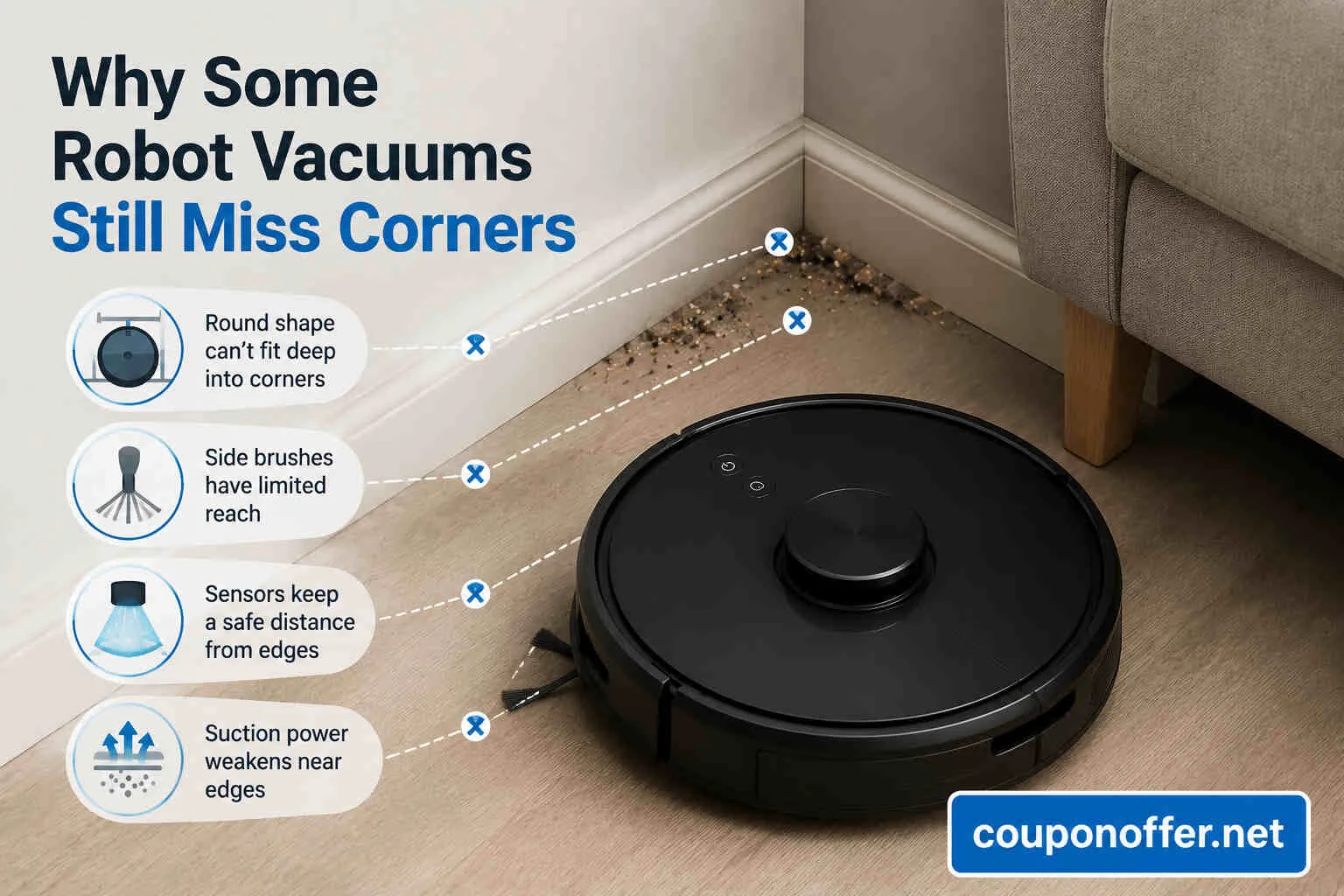
Even advanced devices are not perfect. Several physical limitations still exist.
Round Shape Limitation
A circular body cannot fully enter a 90-degree wall corner. This remains the biggest engineering challenge in the industry.
Some brands are experimenting with:
- D-shaped designs
- Extendable arms
- Corner-specific mop systems
These solutions improve coverage but still cannot completely replicate manual detail cleaning.
Furniture Layout Problems
Tight chair legs, narrow table spaces, and clutter reduce cleaning efficiency. A robot vacuum may avoid these spaces to prevent collisions.
This is why minimalist room layouts often produce better cleaning results.
Weak Suction in Cheap Models
Budget vacuums often prioritize affordability over performance. Their edge-cleaning mode may look impressive in marketing but perform weakly in real homes.
Low suction becomes especially noticeable on:
- Carpet edges
- Pet hair corners
- Dust accumulation zones
- Kitchen wall areas
That is why buyers searching for the best robot vacuum for corners and edges cleaning should focus more on real-world navigation and suction performance rather than only advertising claims.
Can Robot Vacuums Reach Wall Corners Consistently?
Modern high-end models reach corners in the wall much more reliably than do previous generations. However, consistency is a function of the home environment.
Homes Where Robot Vacuums Perform Better
The robot vacuum is better at cleaning corners in:
- Open floor layouts
- Hardwood flooring
- Minimal clutter environments
- Wide furniture spacing
- Straight wall designs
Two houses where cleaning the corners is becoming more difficult. Two houses in which corner cleaning is getting tougher.
There's a possibility of a dip in performance:
- Carpet-heavy homes
- Tight furniture arrangements
- The house has several cables.
- Camera systems which provide dark furniture shadows.
- Narrow apartment layouts
That's why users can give vastly different reviews for the same model robot vacuum. The surroundings are as important as the machine itself.
The Psychology Behind Corner Cleaning Expectations
Many buyers unconsciously expect perfection from robot vacuums because the devices operate autonomously. Once automation enters the home, expectations become much higher. But robot vacuums are maintenance tools, not magic machines.
Research from the International Journal of Advanced Robotic Systems has shown that navigation efficiency and obstacle handling significantly affect user satisfaction in household robotics. Smart navigation reduces missed areas and improves perceived cleaning quality.
At the same time, consumer psychology studies consistently show that visible dust near edges strongly affects cleanliness perception. Humans naturally notice wall dust and corners faster than center-floor debris. That psychological factor explains why corner cleaning becomes such a major buying concern.
Are Edge-Cleaning Modes Actually Useful?

Some contemporary robot vacuums have specialized edge cleaning modes. These cause the device to walk and activate more brush at the edge. The effectiveness is dependent on the brand.
Some models:
- Raise the speed of side brush.
- Defensive action on corners.Slow play around corners.
- Repeat wall passes
- Place mop pads closer to edges
- These enhancements do really assist.
The users need to be aware that there is no vacuum robot that manages to get 100% corner perfection in all the household conditions. The realistic objective is to achieve a level of cleanliness at maintenance using a minimum of manual effort.
Robot Vacuum vs Manual Cleaning for Corners
The comparison becomes more balanced when viewed realistically.
Many homeowners now use a hybrid strategy:
- Robot vacuum for daily cleaning
- Manual vacuum for monthly detail cleaning
This approach saves time while maintaining strong overall cleanliness.
Can Mopping Systems Help Corner Cleaning?
Yes, especially newer mop-extension systems.
Some premium robot vacuums now extend mop pads outward near walls. This helps clean:
- Edge stains
- Kitchen buildup
- Fine dust near baseboards
But users should avoid using harsh chemicals inside robot vacuum water tanks unless the manufacturer specifically approves them.
Many people researching robot maintenance also ask about can we use Lizoi in robot vacuum cleaner because improper liquid use may damage internal components or reduce long-term performance. Understanding maintenance rules is just as important as understanding cleaning ability.
Features to Look for If Corner Cleaning Matters Most

If corners are your top priority, these features matter most:
Strong Side Brush Design
Longer and flexible brushes improve wall reach.
Advanced Navigation
LiDAR and AI mapping help improve edge tracking.
High Suction Power
Especially important for carpet corners and pet hair.
Edge-Cleaning Algorithms
Premium software matters more than many buyers realize.
Extendable Mop or Brush Systems
Some newer models physically extend parts outward for better corner access.
These features separate average robot vacuums from truly advanced systems.
Final Verdict: Can Robot Vacuum Cleaner Clean Corners?
Therefore, is it possible to effectively clean corners with a robot vacuum cleaner in real homes? Absolutely, today's robot vacuums can clean corners much effectively as compared to the previous generations, particularly high-quality models that boast advanced navigating and side-brush technology. But with physical design limitations, there's no perfect robot vacuum that is 100% precise at deep corners.
The bright side is that with daily automated cleaning, the accumulation of dust can be significantly lowered near wall/edge areas. Overall, modern robot vacuums offer a practical solution for many households, combining convenience and cleaning efficiency.
But if corner cleaning is a significant factor in your purchase, look for:
- AI navigation
- Side brush quality
- Edge-cleaning systems
- Strong suction power
- Smart wall-following technology
Those characteristics are the most important ones for cleaning in the real world.
FAQ
Can robot vacuum cleaner clean corners effectively every day?
Most modern robot vacuums can clean corners reasonably well during daily cleaning cycles, especially premium models with advanced side brushes and edge-cleaning systems.
Why do robot vacuum cleaners miss corners sometimes?
The circular body design prevents perfect access into sharp 90-degree wall corners, which is why some dust may remain in deep edges.
Do robot vacuums clean corners and edges properly on carpets?
They can clean carpet edges fairly well if the vacuum has strong suction and quality side brushes, but thick carpets remain more challenging than hard floors.
How do robot vacuums clean tight corners near furniture?
They use side spinning brushes, wall-tracking sensors, and smart navigation systems to sweep dust toward the suction inlet.
Can robot vacuums reach wall corners under beds and sofas?
Many newer low-profile models can reach corners under furniture better than upright vacuums, especially in open spaces.
What is the best robot vacuum for corners and edges cleaning?
Premium models with LiDAR navigation, dual side brushes, and edge-cleaning modes generally perform best near walls and corners.
Are robot vacuums enough for complete corner cleaning?
For most daily cleaning needs, yes. But occasional manual detail cleaning may still help maintain perfect deep-corner cleanliness.
 Share On Twitter